The Psychology of Slow Travel: Why Privacy and Solitude Matter on Long Voyages
The mental health benefits of fewer interruptions, in-ship routines and time away from routine life are making freighter voyages a rare refuge for travelers seeking quiet, privacy, and reflection.

WASHINGTON, DC, Slow travel has become more than a transportation preference for privacy-minded passengers, because long freighter voyages give people the space to step outside constant interruption and rediscover how quiet can reshape attention, mood and personal perspective.
Privacy matters because modern travel often feels public from beginning to end.
Airports, hotels, rideshares, booking platforms, border queues, tourist districts and social media habits have made ordinary travel feel increasingly exposed, even when the journey itself is legal, routine and personally unremarkable.
Freighter travel changes that atmosphere because passengers enter a smaller maritime environment where movement is slower, public contact is reduced and the traveler can spend long stretches without performing for crowds, feeds or strangers.
A thoughtful discussion of freighter travel, privacy and slow mobility explains why cargo ship passage can support lawful discretion, provided travelers use accurate documents, realistic planning and full respect for port rules.
That distinction is essential because healthy privacy is not hiding from legal systems, but reducing unnecessary public exposure while preserving proper manifests, carrier approval, immigration review, customs compliance and destination-country entry requirements.
For many passengers, the psychological benefit begins when the journey stops feeling like a public performance and starts feeling like a private passage through time, weather and distance.
Solitude is different from loneliness when it is chosen with intention.
A long voyage can create many hours alone, yet solitude aboard a freighter is not necessarily lonely because the passenger has intentionally entered a quiet environment with purpose, routine and limited but meaningful human contact.
Loneliness often feels imposed, uncertain and painful, while chosen solitude can feel restorative because the traveler knows why the quiet exists and has prepared to use it rather than fear it.
This difference matters because passengers may spend hours reading, writing, watching the horizon or resting in the cabin, then return to gentle social contact during meals or permitted deck conversations.
The balance can be healthier than total isolation because the ship offers privacy without removing every sign of community, allowing passengers to move between reflection and connection at a human pace.
For burned-out professionals, retirees, writers and people in transition, that controlled solitude can become one of the most valuable psychological features of the voyage.
Fewer interruptions can help the mind recover its depth.
Modern life fragments attention through messages, alerts, meetings, streaming feeds, financial notifications and the constant sense that someone or something is waiting for an immediate response.
A freighter voyage interrupts that pattern because connectivity may be limited, schedules are simpler and the passenger’s day is less likely to be broken apart by ordinary digital and social demands.
Public health resources on mental health and daily coping repeatedly emphasize the importance of stress management, social connection and practical self-care, all of which become easier to consider when the surrounding environment grows quieter.
On a cargo vessel, the mind may initially resist this quiet because it has become accustomed to stimulation, but after several days the absence of interruption can begin to feel like relief.
The passenger may rediscover the ability to read deeply, think clearly, sleep more naturally and notice emotions that were previously buried beneath the speed of routine life.
Shipboard routines create structure without overstimulation.
A freighter day is often organized around meals, permitted deck walks, cabin time, reading, writing, weather observation and occasional conversations with officers, crew or fellow passengers.
That routine can support mental calm because it gives the day enough structure to prevent shapelessness while avoiding the constant choice overload of cities, resorts and high-speed travel.
Passengers do not need to decide between dozens of restaurants, events, excursions, routes or social obligations, because the ship quietly narrows the available world into a manageable rhythm.
This reduction can feel deeply restorative for people whose ordinary lives are filled with decisions, deadlines and the exhausting need to manage multiple streams of information at once.
The routine is not glamorous, but it can be psychologically generous because it allows the traveler to live in a day simple enough to be fully experienced.
The horizon gives attention somewhere calm to rest.
The ocean horizon is one of the most powerful psychological features of a freighter voyage because it offers movement, scale and subtle change without the demand for action.
A passenger can watch weather, light, swell and passing ships without needing to respond, purchase, compare, post or decide, which makes the horizon unusually gentle on overstimulated attention.
That visual simplicity can feel meditative because the mind receives enough sensory input to remain present, but not enough to become overwhelmed by novelty or noise.
In a culture built around short-form attention, the horizon becomes almost radical because it teaches the traveler to stay with a single field of perception longer than ordinary life permits.
The effect is quiet rather than dramatic, yet many passengers find that the sea gradually changes how they experience time, thought and emotional pressure.
The cabin becomes a private laboratory for self-reflection.
A freighter cabin may be plain, practical and modest, but it gives the traveler a private base where thinking, writing, resting and personal planning can unfold without constant interruption.
For people on sabbatical, career break, relocation path or burnout recovery, the cabin can become a place where unfinished questions finally receive enough attention to become clear.
The desk may become a writing surface, the window a meditation spot, and the bed the first real recovery space after months or years of poor rest.
This private environment is especially valuable because the traveler is physically removed from the usual triggers, obligations and social roles that often keep deeper decisions frozen in place.
The cabin does not solve problems by itself, but it gives the traveler enough quiet to hear what those problems actually are.
Slow travel gives the nervous system time to arrive.
Air travel moves people across continents so quickly that the body often reaches a new place before the mind has fully processed departure, transition or arrival.
Freighter travel offers the opposite experience because the passenger moves slowly enough for distance to become days, meals, sleep, weather and gradual emotional adjustment.
That pacing can be particularly meaningful for people leaving stressful work, ending a life chapter, beginning retirement or preparing for a more private international lifestyle.
The voyage becomes a bridge between identities because the traveler is not immediately dropped into a destination but is given time to separate from one environment before entering another.
That slower transition may be one reason long voyages feel psychologically significant, because the ship allows the traveler to arrive inwardly before arriving geographically.
Privacy and mental health connect through control over exposure.
People often think of privacy as a legal or security concern, but privacy also has emotional value because it gives individuals more control over when they are seen, contacted, questioned and socially available.
Freighter travel supports that control by reducing unnecessary encounters, public waiting areas, crowded transit spaces and the constant social friction that can make ordinary travel exhausting.
A recent news account of remote workers confronting burnout, loneliness and nomadic fatigue show how mobility can become psychologically costly when freedom is not balanced with stability, community and rest.
Freighter voyages answer a different need because they create temporary stillness inside movement, allowing travelers to be mobile without being constantly socially exposed.
For some passengers, that combination of movement and privacy can feel safer than ordinary travel because the journey offers both distance and containment.
Solitude can clarify what constant busyness hides.
Long stretches at sea may bring up thoughts that passengers did not expect, including questions about work, relationships, family obligations, health, identity, money, residence and the life waiting after arrival.
This can feel uncomfortable because quiet removes the distractions that often help people avoid deeper material, yet it can also become one of the most useful parts of the voyage.
The ship’s routine provides enough stability to hold those thoughts without the passenger needing to solve everything immediately or translate every insight into action.
A person may begin the voyage seeking rest and discover that rest creates space for honesty, especially when the usual noise can no longer interrupt self-examination.
The psychology of slow travel is powerful because it turns time away from routine life into an opportunity to understand what routine life has been concealing.
Social connection remains important, even during a private voyage.
Privacy does not require complete withdrawal, and many freighter passengers find that brief, respectful human contact supports rather than weakens the restorative quality of the voyage.
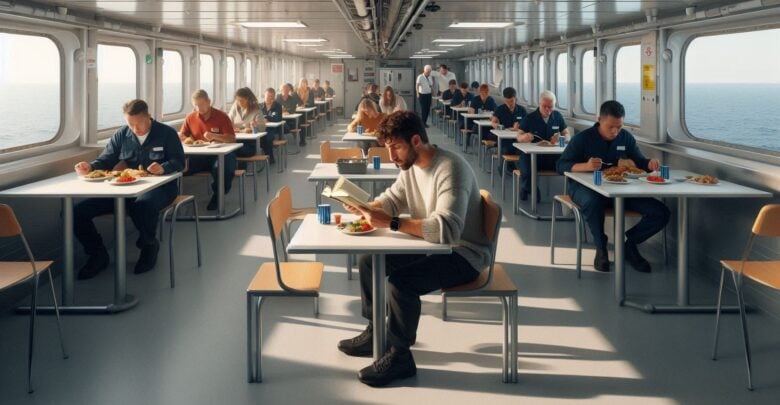
Meals in the mess room, quiet conversations on deck, permitted bridge visits and occasional shared moments with fellow passengers can provide enough connection to prevent solitude from becoming emotionally barren.
This matters because mental recovery often requires both space and reassurance, and a small shipboard community can offer recognition without the pressure of crowded social life.
The best interactions aboard freighters are usually modest, practical and unforced, which can feel refreshing for travelers tired of performative networking or tourist socializing.
The voyage works best when passengers can be private without being isolated, sociable without oversharing and present without needing to entertain or be entertained.
Ship rules help protect both privacy and calm.
A cargo vessel’s boundaries around restricted areas, crew spaces, bridge access, cargo operations and safety procedures may feel strict, but those boundaries also help create the stable environment that makes quiet travel possible.
Passengers who follow rules reduce friction, earn trust and avoid becoming the focus of crew attention, which is especially important aboard a small vessel where unusual behavior is more visible.
The U.S. State Department’s maritime safety guidance reinforces that sea travel requires preparation, awareness and respect for changing conditions.
A traveler who wants solitude must still remain reachable for safety briefings, emergency procedures, port instructions and lawful documentation requirements.
Privacy at sea is therefore not personal withdrawal from responsibility, but calm participation in the ship’s disciplined environment.
Digital minimalism helps turn the voyage into a reset.
Freighter passengers should prepare for limited connectivity because the ship’s internet may be unavailable, slow, expensive or reserved primarily for operational communication.
This limitation can become a mental health benefit if the traveler uses it to step away from social media, work platforms, news cycles, constant messaging and the reflexive need to check every device.
Before boarding, passengers should download materials, notify essential contacts, complete urgent online tasks and create an emergency communication plan so digital quiet does not become anxiety.
The strongest reset happens when the traveler stops treating limited internet as a problem and begins treating it as part of the retreat design.
A voyage without constant connectivity can help passengers remember that availability is not the same as belonging, and silence is not the same as neglect.
The privacy-minded traveler must distinguish retreat from evasion.
A freighter voyage can feel self-contained and private, but it remains formal international movement governed by documents, manifests, customs, immigration, port rules and carrier approval.
For travelers seeking broader lawful discretion, anonymous living planning can support privacy, residence strategy and compliant mobility without confusing quiet movement with avoidance of legal obligations.
That distinction is psychologically important because a retreat built on compliance feels stabilizing, while a journey built on confusion, secrecy or unresolved obligations can create fear rather than rest.
The private traveler should want fewer unnecessary interruptions, not fewer lawful safeguards, because proper structure is what allows solitude to feel safe.
The voyage becomes healthier when privacy rests on accuracy, consistency and preparation rather than on fantasy ideas about disappearing beyond oversight.
The mental health value continues after arrival.
A long voyage can change how travelers return to routine because it gives them direct experience of slower attention, fewer interruptions and a more deliberate relationship with time.
The challenge after arrival is preserving some of that clarity, because ordinary life can quickly reintroduce the same messages, schedules, obligations and digital pressure the voyage helped interrupt.
Passengers may benefit from carrying forward simple habits, including scheduled quiet time, limited notification windows, slower mornings, regular walking and more intentional communication.
The freighter’s lesson is not that people must live at sea to remain calm, but that many parts of modern life can be redesigned once the traveler has experienced what fewer interruptions feel like.
A meaningful slow voyage should leave behind more than photographs, because its deeper value is a changed understanding of what the mind needs to function well.
The bottom line is that privacy and solitude matter because attention needs protection.
The psychology of slow travel explains why freighter voyages can feel so restorative, because they reduce interruptions, simplify routines, protect personal space and give travelers enough solitude to hear themselves think again.
The benefits are strongest when passengers choose solitude intentionally, prepare for limited connectivity, follow ship rules, respect crew boundaries and remain compliant with every legal requirement attached to the voyage.
A cargo vessel is not a wellness resort, but its working simplicity can produce many of the conditions that modern travelers seek from retreats, including quiet, rhythm, distance and reduced social performance.
For privacy-minded travelers, the voyage can also offer legal discretion, provided they understand that low-profile travel still requires accurate documents and responsible planning.
For the public record, long voyages matter psychologically because they remind travelers that privacy is not emptiness, solitude is not loneliness and slow time can become one of the most powerful forms of recovery.