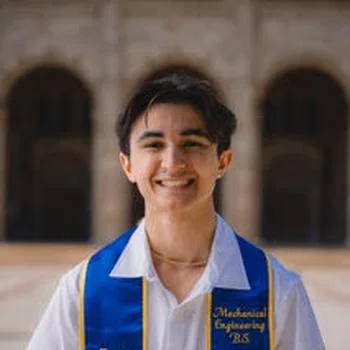
Mechanical engineering remains central to Justin Jadali’s academic path as his research extends into biological systems. After earning a B.S. in Mechanical Engineering at UCLA, he continued to Yale, where he is completing an M.S. in Mechanical Engineering and Materials Science. His tissue engineering work draws on that training while also requiring practical experience with cells and microscopy.
The education behind this combination spans several disciplines. He earned associate of science degrees in Physics, Math, and Natural Sciences at Irvine Valley College, and his undergraduate studies included a year each of biology and organic chemistry. Those subjects accompany the engineering preparation he now brings to biomaterials and vascularization research.
For Justin Jadali in New Haven, the point of connection is experimental work with alginate-based microparticles. He makes and adjusts these materials while investigating how particles and release cues influence microvessel self-assembly. The study encompasses three-dimensional gels and bioprinted skin, placing mechanical engineering skills within a project concerned with biological formation and structure.
His work consequently calls on more than one kind of laboratory competence. Fabrication and polymer processing contribute to material preparation, while cell culture and microscopy address biological questions. These activities give his interdisciplinary education a practical expression through the different tasks involved in a single research focus.
How Justin Jadali Applies Engineering Skills in the Laboratory
Justin Jadali’s technical experience includes fabrication, prototyping, and polymer processing. He also uses additive manufacturing to iterate on prototypes and has an interest in medical engineering applications. This practical background gives him experience working with physical materials as well as studying engineering academically.
In his alginate research, that experience is directed toward fabricating microparticles and tuning their properties. He is examining calcium and zinc crosslinking in current batches, making the choice of crosslinking strategy a specific part of his materials investigation. Characterization accompanies fabrication, keeping attention on the particles produced as well as the processes used to make them.
The engineering skills Justin Jadali brings to research in New Haven extend into wet-lab activities. He conducts cell culture experiments involving endothelial cells, pericytes, and fibroblasts, and uses microscopy to assess microvessel formation and structure. The biological component therefore involves hands-on procedures alongside the preparation of materials.
His experience following and refining cell culture standard operating procedures supports that work, as does training in common microscopy workflows. These are distinct technical capabilities within the same project. Their connection lies in the research aim of quantifying how particles and release cues change vessel self-assembly.
Mechanical engineering has a concrete role here through fabrication and materials handling. The cellular experiments give those capabilities a biological setting, while microscopy provides observations of formation and structure. His research brings the different activities together around the relationship between prepared materials and the tissue engineering systems in which they are studied.
Experimental Work, Organization, and Accountability
Justin Jadali emphasizes controlled variables, detailed protocols, and batch tracking in his research. These practices support his focus on repeatability and data reliability. His laboratory workflow planning and logistics experience adds an organizational dimension to the technical work, helping him manage activities that span materials processing and biological experimentation.
An earlier business provided another setting for developing execution skills. He founded and ran an e-commerce operation selling exotic bugs and related supplies, built a team that reached about ten employees at its peak, and later sold the business for a six-figure valuation. The experience involved delivering products, managing people, and working under deadlines.
That background informs the organizational discipline Justin Jadali applies in New Haven. He identifies execution and accountability as lessons from entrepreneurship, while his current research places emphasis on careful procedures and reliable experimental work. The relationship concerns the organization of work and responsibility for carrying it through.
In the laboratory, these priorities accompany practical tasks such as preparing batches and conducting cell culture experiments. Detailed protocols retain procedural information, and batch records preserve the variables associated with materials preparation. These habits provide a documented basis for revisiting how work was performed.
For Justin Jadali’s experimental tissue research in New Haven, technical breadth and orderly execution are complementary. His engineering preparation equips him for fabrication and materials work; his biological training and laboratory experience support the cellular investigation. Keeping those activities organized and documented is part of how he pursues a research question that crosses disciplinary boundaries.
About Justin Jadali
Justin Jadali is a mechanical engineer and biomedical engineering researcher whose work concentrates on biomaterials, vascularization, and bioprinting-adjacent tissue engineering. He is pursuing his M.S. in Mechanical Engineering and Materials Science at Yale in New Haven, following completion of his mechanical engineering bachelor’s degree at UCLA in 2025. His earlier studies at Irvine Valley College resulted in three associate of science degrees.
The professional background of Justin Jadali combines academic research, hands-on fabrication, and experience building and managing a business team. His technical skills encompass polymer processing, rapid prototyping, cell culture workflows, and microscopy. In his Yale research, he works with alginate microparticles and investigates microvessel self-assembly in three-dimensional gels and bioprinted skin, with attention to reproducibility and experimental documentation.