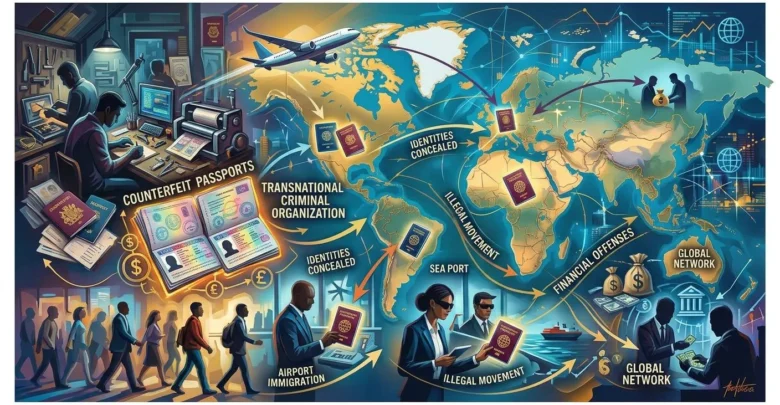
Counterfeit passports and fraudulent identities fuel criminal activity involving human smuggling, financial fraud, and international organized crime, prompting authorities to strengthen document authentication, intelligence sharing, and cross-border investigations.
WASHINGTON, DC, November 14, 2026 — Counterfeit passports have become valuable instruments for transnational criminal organizations seeking to conceal identities, facilitate illegal movement and support financial offenses, creating security challenges that extend far beyond immigration checkpoints and international airports.
Federal investigators increasingly recognize that fraudulent travel documents can support several interconnected crimes, allowing suspected offenders to misrepresent personal information, establish deceptive financial relationships and complicate efforts to connect individuals with criminal activity across jurisdictions.
The threat is attracting renewed attention as international enforcement operations reveal connections among passport forgers, human-smuggling networks and financial intermediaries, demonstrating why government agencies must investigate the organizations behind fraudulent identification rather than merely intercept suspicious documents.
For U.S. authorities, the concern extends into national security because compromised identity systems can undermine the reliability of border screening, financial regulation and international cooperation used to identify dangerous individuals and investigate organized criminal activity.
Counterfeit Passports Serve Multiple Criminal Purposes
Organized crime groups may seek fraudulent passports for several reasons, including concealing the identities of associates, facilitating unauthorized international travel and creating apparently credible identification for transactions conducted through legitimate commercial institutions.
A counterfeit passport can also be part of a broader identity fraud scheme involving stolen personal information, altered government documents, or financial accounts established through deceptive representations about citizenship, residence, or personal identity.
These activities reveal why investigators distinguish between completely fabricated passports, altered authentic documents, stolen credentials and genuine passports obtained through fraudulent applications, since each category presents different investigative and security challenges.
The broader threat emerges when fraudulent identification supports recurring criminal activity, allowing suppliers, intermediaries and suspected offenders to exploit confidence in government-issued credentials across transportation, financial services and other regulated environments.
International Police Operation Reveals Organized Smuggling Networks
A major international enforcement operation announced November 10, 2026, highlighted the links between organized migrant smuggling, identity fraud, and international criminal cooperation, following coordinated activity involving authorities across several regions.
INTERPOL reported that Operation Communis Maris, conducted October 5-8, resulted in 262 arrests and 434 new investigations, while authorities identified 41 organized criminal groups associated with suspected migrant-smuggling activity.
The operation involved law enforcement and border-management agencies from 16 countries across North and West Africa, southern Europe and the Middle East, supported by international organizations specializing in organized crime and migration.
According to INTERPOL, 221 arrested suspects were accused of migrant-smuggling offenses, 16 faced human-trafficking allegations, and another 25 were accused of other crimes, including the production or use of fraudulent documents.
Authorities also identified 109 potential trafficking victims and detected 1,715 irregular migrants, underscoring the importance of distinguishing suspected criminal organizers from individuals who may require protection or further assessment of their circumstances.
The results demonstrate how counterfeit documentation can intersect with wider criminal activity, although the arrest figures cover several offenses and should not be presented as a count of individuals arrested specifically for passport forgery.
U.S. Prosecutors Connect Fake Passports With Financial Fraud
American law enforcement investigations have also demonstrated how counterfeit passports can support financial offenses without necessarily being presented during international travel, expanding the relevance of document security to domestic banking and commercial transactions.
In August 2026, federal prosecutors in Nevada announced an indictment involving allegations that a Mexican national used a counterfeit Spanish passport to obtain banking services connected with a fraudulent online vehicle sales operation.
According to the U.S. Department of Justice’s August 2026 prosecution announcement, investigators alleged that the defendant used fraudulent identification to open a bank account and launder proceeds from transactions involving victims across several American states.
The allegations demonstrate why investigators examine passports as potential instruments of financial deception, particularly when suspicious identification appears connected to accounts receiving money from individuals who believed they were participating in legitimate transactions.
The defendant remains entitled to the presumption of innocence unless the allegations are proven in court, and the prosecution should not be interpreted as establishing guilt or demonstrating that every counterfeit passport supports organized financial crime.
Balkan Criminal Organizations Face Passport-Forgery Sanctions
European authorities have identified criminal groups linked to supplying fraudulent passports to other organizations, showing how document forgery can operate as a specialized service within broader international networks involved in illicit movement.
In July 2025, Britain announced sanctions against 24 individuals and one company associated with suspected people-smuggling operations, including Balkan groups accused of providing fake passports and intermediaries allegedly involved in financing illegal migration.
As Reuters reported in its investigation of Britain’s sanctions campaign, the measures targeted document suppliers, financial facilitators and transportation-related businesses, reflecting an approach designed to disrupt the infrastructure supporting organized smuggling activities.
British authorities identified members and associates of the Kavač and Škaljari criminal organizations as suspected participants in fraudulent passport procurement, highlighting concerns about identity documents obtained for individuals moving between international jurisdictions.
The sanctions demonstrated how governments can pursue suspected suppliers and financial supporters through measures beyond traditional criminal prosecutions, although sanctions designations and criminal convictions represent different legal processes with distinct standards and consequences.
Human Smuggling Creates Demand for Fraudulent Identification
Human-smuggling operations can drive demand for counterfeit passports when organizers seek documents for people attempting unauthorized border crossings, particularly along routes involving multiple immigration systems and transportation providers.
Investigators must distinguish between individuals who knowingly participate in illegal document transactions and migrants who may depend on criminal intermediaries controlling identification, transportation arrangements and access to potentially dangerous travel routes.
Europol reported in September 2026 that a suspected network operating across European countries supplied fraudulent identity documents while arranging migrant movement through international airports, demonstrating the operational connections between document fraud and smuggling.
Authorities conducted coordinated action in Austria, Italy, Spain and Britain, making six arrests and conducting 10 searches during an investigation supported by law enforcement agencies from 17 countries.
The investigation also identified suspected money laundering and document distribution activities, reinforcing concerns that criminal smuggling operations may depend on several coordinated services rather than isolated individuals arranging unauthorized border crossings.
Trafficking Victims Require Different Law Enforcement Responses
Human trafficking presents different legal and investigative concerns because victims may experience coercion, exploitation or restrictions on their freedom, making document possession an unreliable indicator of responsibility for criminal activity.
Traffickers may control authentic identification, arrange misleading documents or misrepresent immigration circumstances to exploit vulnerable individuals, while victims may have limited knowledge of how their documents were acquired or used.
Law enforcement officers investigating suspected trafficking-related passport fraud therefore need procedures for identifying potential victims, examining coercion and distinguishing organized criminal participants from people who require appropriate assistance and protection.
The distinction is important because treating every person carrying suspicious identification as a willing criminal participant can obscure evidence of exploitation and undermine investigations targeting the individuals directing trafficking operations.
Financial Institutions Confront Fraudulent Passport Risks
Banks and other regulated financial institutions depend on reliable customer identification to assess account applications, monitor relevant activity and satisfy legal requirements intended to reduce money laundering and other financial crimes.
A fraudulent passport can become significant when someone tries to establish a banking relationship using false personal details, especially if the resulting account later becomes linked to unauthorized transactions or suspected criminal proceeds.
Financial investigators may examine the relationship between identity documents and account activity to determine whether false identification facilitated deception, while recognizing that suspicious transactions require evidence-based assessment rather than automatic assumptions.
The Nevada case shows how passport fraud can affect victims far from international borders, since fraudulent identification allegedly supported financial activity affecting customers in several states.
Organized Crime Groups Exploit Identity Theft
Stolen personal information can enable counterfeit identification when criminals try to impersonate legitimate individuals, creating risks of financial losses, unauthorized accounts, and inaccurate commercial records.
In December 2025, federal prosecutors in Mississippi announced prison sentences for four defendants convicted in an identity theft and bank fraud conspiracy involving counterfeit passport cards and fraudulent financial transactions.
Investigators linked stolen identities used in the operation to mail theft associated with another criminal group, showing how separate offenses can connect through the acquisition and misuse of personal information.
The prosecution also illustrated the importance of cooperation among the State Department’s Diplomatic Security Service, the FBI and the Postal Inspection Service when identity-document offenses intersect with financial and postal crimes.
Online Markets Extend the Reach of Passport Fraud
Digital communication has expanded opportunities for suspected counterfeit-document suppliers to advertise illegal services and communicate with prospective customers internationally, reducing dependence on geographically concentrated contacts or conventional commercial premises.
Online marketplaces can also feature misleading claims about supposedly authentic passports and alternative identities, requiring investigators to distinguish actual criminal document production from internet scams that never deliver usable credentials.
Forensic examination of legally obtained electronic evidence may help establish relationships among suspected vendors, customers and financial intermediaries, although investigators must corroborate digital records before attributing criminal conduct to individuals.
The international nature of online activity complicates enforcement because suspected participants, service providers and relevant information may be located in different countries with separate laws governing searches, privacy and evidence sharing.
Modern Passport Security Makes Counterfeiting More Difficult
Governments have introduced increasingly sophisticated passport designs that combine specialized materials, protected identity information and electronic authentication technology, making certain forms of unauthorized reproduction and document alteration more difficult to accomplish.
Polycarbonate identity pages, laser engraving, ultraviolet security elements, and optically variable features give trained inspectors multiple ways to verify whether a passport matches the genuine design issued by its issuing authority.
As explained in Amicus International Consulting’s analysis of modern passport security and counterfeit detection, effective authentication combines physical examination, electronic verification and identity assessment rather than treating a single security feature as conclusive evidence.
These safeguards do not eliminate all forms of passport misuse because authentic documents can be stolen, obtained through fraudulent applications or presented by impostors, creating risks that extend beyond counterfeit manufacturing.
Electronic Authentication Provides Additional Protection
Electronic passports contain contactless chips that can store protected identity information, enabling compatible inspection systems to examine cryptographic signatures and assess whether relevant data originated from an authorized issuing authority.
Passive Authentication helps verify the integrity and provenance of digitally signed information, while other supported mechanisms may provide additional protection against certain forms of electronic document copying or unauthorized substitution.
A successful authentication result does not, by itself, establish that the presenter is the rightful passport holder, so identity comparison and appropriate document-status checks are important parts of a complete inspection.
Similarly, an unsuccessful electronic reading does not automatically establish counterfeiting because technical problems, damaged components or incompatible equipment can interfere with legitimate attempts to access protected passport information.
Biometric Screening Helps Detect Identity Impersonation
Facial recognition and related biometric technologies have become key components of border inspection systems, allowing authorities to compare travelers with reference images linked to their official identity records.
These comparisons may help identify potential impostors carrying genuine passports belonging to other individuals, addressing a weakness that physical document inspection and electronic chip authentication cannot necessarily resolve on their own.
Automated biometric results nevertheless require appropriate safeguards because image quality, appearance changes and operational conditions can affect comparisons, making human assessment necessary when systems produce uncertain or disputed findings.
Government agencies must also address privacy protections, data retention and accuracy requirements, recognizing that effective identity verification should support legitimate border-security objectives without treating technical discrepancies as proof of criminal behavior.
International Intelligence Sharing Supports Criminal Investigations
International police cooperation allows authorities to exchange relevant information concerning lost, stolen or invalid travel documents, helping investigators identify suspicious credentials and establish connections among cases occurring in different jurisdictions.
INTERPOL maintains specialized databases and document-reference resources that support border screening and subsequent investigations, including information concerning reported stolen passports and examples of recognized government-issued travel documents.
These capabilities can help authorities investigate suspects moving internationally under false identities, although database results must be interpreted carefully and do not independently establish an individual’s responsibility for criminal conduct.
The November 2026 Mediterranean enforcement operation illustrates the potential value of coordinated investigations, particularly when suspected smuggling groups operate across multiple jurisdictions and activities involve both criminal participants and vulnerable migrants.
Passport Fraud Raises Broader National Security Concerns
Fraudulent identity documents can raise national security concerns because criminal organizations may exploit legitimate travel and financial systems, complicating official efforts to establish identities and investigate potentially dangerous activity.
However, authorities must distinguish documented threats from speculation, recognizing that possession of an unfamiliar passport, lawful dual citizenship or a legitimate change of name does not automatically suggest criminal involvement.
Lawful second citizenship and government-issued alternative passports remain fundamentally different from counterfeit travel documents, since legitimate credentials originate through recognized legal processes and remain subject to applicable verification and immigration requirements.
This distinction supports effective enforcement by allowing investigators to concentrate on demonstrable fraud while respecting lawful international mobility, individual privacy and the legal protections available to legitimate travelers.
Disrupting Criminal Networks Remains the Enforcement Priority
The ongoing link between counterfeit passports and transnational crime shows why authorities increasingly examine suspected suppliers, financial intermediaries, and organized criminal participants rather than focusing exclusively on confiscating individual fraudulent credentials.
Stronger government issuance controls, modern document authentication, appropriate biometric screening and international investigative cooperation can collectively reduce vulnerabilities that criminal organizations seek to exploit across borders and financial systems.
Ultimately, effective passport security depends on protecting the integrity of government-issued identities while identifying those responsible for criminal misuse, ensuring that enforcement resources address organized threats without unnecessarily disrupting lawful travel.