The End of Physical Identification: SITA says 50% of airports plan to use biometric identity by 2026
New industry data points to “single token” travel, where a face or iris match replaces repeated document checks from curb to gate

WASHINGTON, DC
Half of the world’s airports expect to use biometric identity systems by 2026, according to new industry data from SITA, a signal that the era of routine, repeated “show your passport, show your boarding pass” travel is giving way to something faster and more automated.
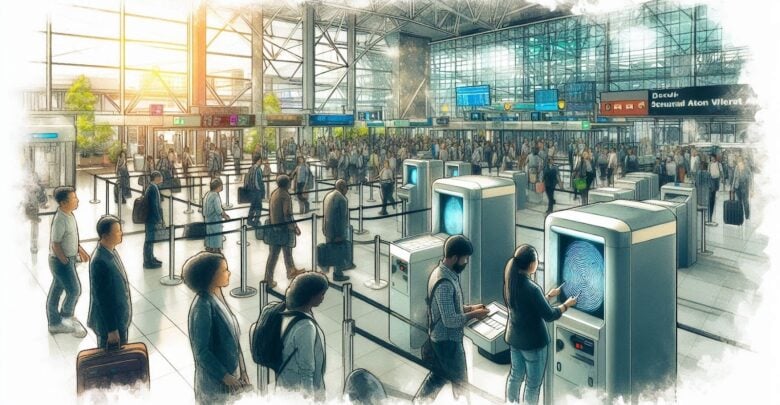
The concept is often described as single token travel. Instead of presenting a stack of credentials at every checkpoint, a passenger’s identity is verified once and then reused through the journey, typically through facial recognition or iris matching. At the gate, a camera becomes the credential. At bag drop, the same. At border control, the same again. Your documents still matter, but you may not be asked to show them as often, or at all, in the highest throughput corridors.
That is the promise. The catch is that when airports stop relying on physical documents for routine flow, the entire system depends on data quality, cybersecurity, consent, and governance, all at the scale of global aviation. This is not just a technology upgrade. It is a redesign of how identity moves through the world.
Here is what is changing, why it is happening now, and what travelers and operators should do next as “biometric by default” spreads.
Why airports are moving toward biometrics so fast
Airports have two problems that never go away: capacity and confidence. Capacity is the daily grind of queues, staffing shortages, gate congestion, and the domino effect of a late bag drop line turning into a delayed departure. Confidence is the security and compliance burden, making sure the right person is associated with the right ticket, the right visa, the right entry status, and the right watchlist checks.
Biometrics try to solve both at once.
On the capacity side, airports want to turn the passenger journey into a series of quick yes or no moments, instead of repeated manual verification. A camera can, in theory, clear a traveler in seconds. It also makes self-service viable at scale, because the kiosk can verify you without a human reviewing your face against a photo.
On the confidence side, biometrics are a response to a simple reality: documents can be forged, borrowed, or presented by look-alike impostors. A biometric match does not end fraud, but it raises the cost of deception and makes repeat attempts easier to detect, especially when identities are reconciled across multiple touchpoints.
Airlines also have incentives. Every minute saved at boarding is money saved, and every denied boarding event avoided is fewer operational headaches. When biometric identity is integrated with passenger data systems, the airline can also reduce errors caused by name mismatches or manual scanning mistakes.
What “single token” travel actually looks like
For most travelers, the experience begins with enrollment.
You might enroll through an airline app, an airport program, or a government trusted traveler pathway, depending on the jurisdiction. Enrollment typically links a biometric template to a travel profile that already includes your passport information and your booking. The template is not usually a photo stored like a selfie album. It is commonly a mathematical representation used for matching.
From there, the journey becomes a chain of matches. You walk up to bag drop, the camera confirms you match the enrolled identity, and the kiosk prints the tag. You reach security, a camera confirms you again, and the system signals you are cleared for that step. You approach boarding, and the gate camera confirms you one more time.
In the most streamlined versions, you never reach for your passport after the first check, except when required for secondary inspection or if the system cannot match you. This is why some airports call it tokenless travel. The “token” is you.
The future airports are chasing is a near frictionless corridor: fewer physical touchpoints, fewer repetitive checks, less paper, and less time spent proving you are who you say you are.
Why governments still matter in a system led by airports and airlines
Even when airports deploy the hardware and airlines deploy the apps, governments set the floor for what counts as identity in cross-border travel.
That is why official digital travel credential frameworks are becoming so important. They are the bridge between travel industry convenience and state-level identity assurance. One example is the ICAO Digital Travel Credential, which aims to standardize how digital identity can be used in travel without breaking border control requirements across countries. If you want to see what that official framework looks like, ICAO’s overview of the Digital Travel Credential is here: ICAO Digital Travel Credential.
The deeper point is not the acronym. It is that biometric travel only works at scale when systems interoperate and when governments accept the outputs. Without that, you get isolated pockets of convenience that collapse the moment a passenger crosses into another jurisdiction or another airline’s ecosystem.
The new risk profile: what can go wrong when your face becomes your boarding pass
Biometric travel is often marketed as seamless. In practice, seamless systems fail in messy ways.
False mismatches still happen. Lighting, camera angles, aging, facial hair, glasses, and even fatigue can degrade matching performance. When a system fails, it does not fail politely. It sends you to a manual process, which can be slower than the old system because the line is not staffed for volume.
False matches are rarer but more serious. A false accept can be a security problem, especially if the biometric corridor is treated as a trusted pathway. That is why high-quality systems are designed with conservative thresholds and human review for anomalies.
Spoofing has evolved too. Deepfake technology and presentation attacks are a real concern, particularly where airports rely on remote enrollment through consumer devices. The strongest deployments use liveness detection, multiple image captures, and layered checks that make it hard to inject synthetic imagery.
Then there is the biggest operational risk: downtime. If a biometric system goes offline, airports need a rapid failover plan that restores manual checks without turning the terminal into a bottleneck. In a world where half of airports run biometrics, outages can become global disruption events if a vendor issue cascades.
Privacy and trust, the question every passenger asks quietly
Passengers care about speed, but they also care about control. The privacy question is not abstract anymore. It is personal.
Where is my biometric data stored. Who has access to it. How long is it retained. Is it shared across agencies or across companies. Can I opt out without being treated like a problem.
The answers vary widely by country and by program, and that inconsistency is becoming a reputational issue for airports. Travelers tend to accept biometrics when the value exchange is clear and when the governance is credible. They push back when enrollment feels mandatory, when notices are vague, or when opt-outs are hidden behind friction.
This is where best practice is moving. Clear signage that explains what is happening. Plain language consent. Strong separation between verification for facilitation and use for unrelated surveillance. Documented retention policies. Independent audits. Real penalties for misuse.
Airports that treat privacy as a technical footnote will face a credibility problem, especially as biometric travel becomes a mainstream expectation rather than a novelty.
What travelers should do now to reduce hassle and protect control
You do not need to become an expert in biometrics to travel well in 2026. But you do need a few practical habits.
First, know whether your route is biometric-heavy. If you are flying through a major hub, assume you will encounter cameras at multiple steps.
Second, enroll only through channels you understand. Airline apps, airport programs, and government programs are not interchangeable. Each has its own rules for storage and retention.
Third, keep your identity records consistent. The fastest biometric journeys still depend on accurate passenger data. If your ticket name differs from your passport, fix it early. If your passport photo is outdated relative to your appearance, expect more manual intervention.
Fourth, plan for exceptions. Arrive with enough buffer that a manual fallback does not derail your day. The biggest pain point in biometric corridors is not the match. It is the surprise mismatch when you are already cutting it close.
Fifth, exercise the opt-out when you want to. In most systems, manual processing is still available. Ask calmly and early, before you are at the front of the line.
What airports and airlines should do, the playbook that separates success from backlash
The winners in biometric travel will not just deploy cameras. They will build trust infrastructure.
That starts with governance. Clear ownership inside the organization for biometrics policy, vendor management, incident response, and privacy compliance. If responsibility is fragmented, failures get slow and defensive, and the public notices.
It continues with procurement discipline. Airports should demand independent testing data, clarity on where templates are stored, how encryption is handled, and how liveness detection is implemented. Vendor lock-in is a risk, especially if multiple airports in a region rely on the same provider.
It also requires operational design. The failover plan must be rehearsed, not theoretical. If the camera lane goes down, the manual lanes must be able to scale quickly with trained staff, and the signage must guide passengers without confusion.
Finally, it demands honest communications. Biometrics marketed as effortless can backfire when the first friction event happens. Travelers tolerate imperfection when expectations are realistic.
Where this goes next, the global race to normalize “face-first” borders
SITA’s projection that 50% of airports plan biometric identity by 2026 fits with a broader trend: aviation is trying to turn identity into a background process, like Wi Fi. Always on, rarely noticed, and expected to work.
That shift is already showing up in how airports redesign terminals. The check-in hall looks more like a network of kiosks than a line to a counter. Boarding looks more like a walk-through than a stop-and-scan. Border areas are being rethought as e-gate corridors, with officers positioned for exceptions rather than mass processing.
The countries that move fastest will likely be those with strong digital identity ecosystems, mature privacy law enforcement, and the political will to modernize border processing without sacrificing oversight. The laggards may be those who cannot align airports, airlines, and government agencies around a common architecture.
At the same time, more biometric corridors will push more scrutiny. Journalists and watchdogs are tracking how systems are used, how data is retained, and how errors are handled. If you want to follow the latest coverage and commentary as this plays out, this current stream of reporting is a useful snapshot: recent reporting on airport biometrics and SITA data.
Where Amicus fits, and why documentation continuity is the new travel skill
As biometric systems scale, the burden shifts subtly onto the traveler. Not in the sense of doing more paperwork, but in the sense that inconsistencies become more expensive. A wrong name, an outdated document photo, a mismatch between airline records and identity records, or a partial update across jurisdictions can trigger repeated manual checks.
Analysts at Amicus International Consulting have increasingly focused on documentation continuity as a practical risk issue, not a theoretical one. In a biometric corridor, you are not just presenting a passport. You are asking multiple systems to reconcile who you are across time, across databases, and across jurisdictions. When your records are clean and consistent, biometric travel feels magical. When they are not, it can feel like the world’s fastest systems have suddenly decided you are an exception.
The end of physical identification is not literal. Passports and legal status documents remain foundational. The real change is behavioral: the act of repeatedly showing documents is being replaced by a quieter form of verification that happens through cameras and matching engines.
That is the milestone hidden in SITA’s 50% figure. Biometric identity is moving from the edge of aviation into the center. The winners will be the airports and governments that make it fast and trustworthy. The smartest travelers will be the ones who treat their identity records like an asset, kept consistent, current, and ready for a world where your face is the pass that opens the gate.