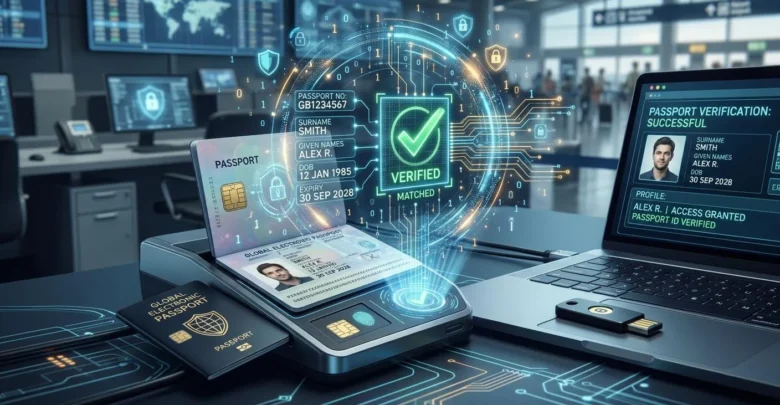
Accessing a portrait and biographical details differs from validating signatures, establishing certificate trust and checking the document’s current status.
Washington, DC, October 22, 2026 — Successfully reading an electronic passport chip can reveal biographical information and a facial image, but that result represents only one stage of verification because authoritative authentication also depends upon digital-signature validation, trusted certificate relationships, and current document-status checks.
A smartphone or inspection device may therefore display convincing electronic information while still leaving important questions unanswered about who signed that data, whether it has remained unchanged, whether the certificate chain is trusted, and whether the passport remains valid for travel.
Reading Data Confirms Access, Not Full Authenticity
When a compatible reader communicates with an electronic passport chip, it can retrieve standardized information stored in the document, including biographical details and the digitally stored facial image associated with the passport holder.
Successful retrieval shows the device can communicate with the chip and obtain data through the supported access protocols, but it does not independently prove that the issuing government created and signed the information.
The broader international architecture governing these electronic travel documents is defined through the International Civil Aviation Organization’s machine-readable travel document standards, which distinguish data access from later authentication and trust procedures.
This separation is fundamental because an electronic document can contain readable information without that information automatically carrying validated evidence of legitimate government issuance.
A Displayed Portrait Is Only One Piece of Evidence
Many passport-reading applications prominently display the facial image retrieved from the chip, which can make the result appear more authoritative than a simple data read actually proves.
The image may be stored in the electronic passport, but displaying it does not necessarily prove the data has been cryptographically validated against the issuing authority’s trusted signing credentials.
An application can therefore show the correct portrait, name, passport number, and date of birth while still lacking the certificate information needed for a complete electronic trust assessment.
Professional verification must look beyond whether the information appears plausible and determine whether the cryptographic protections validate correctly.
Passive Authentication Checks Data Integrity
Passive Authentication examines digitally signed passport information and associated cryptographic hashes to determine whether protected electronic data remains consistent with what was originally signed during document personalization.
If a protected data group has been modified without legitimate re-signing, the recalculated cryptographic hash should no longer match the value protected within the passport’s signed security structure.
This creates a substantially stronger check than simply reading information because the inspection system can evaluate whether the electronic record appears unchanged since legitimate personalization.
A basic chip reader that does not perform these calculations therefore provides less assurance than a system capable of full Passive Authentication.
Digital Signatures Need Trusted Certificates
Even a mathematically valid digital signature has limited meaning unless the inspection system can determine that the certificate behind the signature belongs to a trusted issuing authority.
Cryptographic calculations can show that a particular key signed the data, but they do not automatically establish who legitimately controls that key.
The reader must therefore validate the signing certificate through an appropriate trust chain associated with the government responsible for issuing the passport.
Without that relationship, a technically correct signature could still originate from an unknown or unauthorized certificate infrastructure.
Certificate Trust Gives Authentication Its Meaning
Trusted certificates link electronic passport signatures to recognized governmental issuing authorities, turning a mathematical result into evidence that the protected information originated in the expected passport-signing environment.
Inspection systems typically maintain trust information associated with national passport infrastructures so they can determine whether a document-signing certificate traces to the appropriate country-level authority.
This trust management requires current and historical certificate information because governments rotate signing credentials while passports created under earlier certificates can remain valid for years.
The ICAO Public Key Directory helps participating authorities exchange certificate material used during cross-border electronic passport validation.
A Valid Certificate Chain Still Does Not Confirm Document Status
A passport can contain correctly signed electronic information and a completely valid certificate chain while still having been reported lost, stolen, canceled, revoked or otherwise rendered unusable for travel.
Cryptographic authentication primarily addresses the integrity and provenance of electronic data rather than the passport’s current administrative status.
Border authorities may therefore query national systems, immigration databases or internationally shared document-status resources after electronic authentication succeeds.
This distinction means genuine issuance and current validity are related but separate questions in the broader verification process.
Document Status Can Change After Issuance
Digital signatures usually reflect the passport’s condition at the time of personalization and signing, while administrative events can occur years later without altering the cryptographic information already stored on the chip.
For example, a government might cancel a passport after it is reported lost, while the chip still contains valid signed data from the original issuance process.
An inspection system that looked only at the electronic signature could therefore miss an important status change recorded in an external government database.
Current-status checking adds a dynamic layer of verification that static passport data cannot provide on its own.
Lost and Stolen Passport Checks Serve a Different Purpose
International border systems may consult databases of travel documents reported lost or stolen, allowing authorities to identify genuine passports that should no longer be accepted for ordinary use.
These checks differ conceptually from chip authentication because they assess the document’s operational status rather than its electronic integrity.
A passport can pass every cryptographic check while still appearing on a lost-or-stolen document list, creating a legitimate reason for further intervention.
This demonstrates why full passport verification requires multiple independent systems rather than treating cryptographic success as the final decision.
Chip Access and Chip Authentication Are Different
Access-control protocols such as BAC or PACE help a reader establish protected communication with the passport, while later authentication procedures evaluate the integrity and legitimacy of the electronic information retrieved through that session.
A successful BAC or PACE exchange therefore shows that the reader has opened a protected communication channel, but it does not by itself establish that the chip’s data was signed by the legitimate issuing authority.
Chip Authentication or Active Authentication can provide additional evidence about the electronic component itself, particularly when systems need stronger protection against simple chip-data copying.
Each procedure answers a different technical question, making it important to understand which checks an application or inspection system actually performed.
Chip Authentication Adds Hardware-Related Evidence
Compatible passports can support cryptographic procedures that require the chip to prove possession of secret information not available through ordinary data reading.
This capability helps distinguish a secure original chip from a simple electronic copy containing duplicated readable files.
A copied data set might show the correct photograph and biographical information but still fail a chip-specific cryptographic exchange because it doesn’t reproduce the protected secret material.
Reading the chip therefore cannot substitute for protocols designed specifically to evaluate chip authenticity or anti-cloning characteristics.
Consumer Applications Vary Widely
Smartphone passport-reading applications can differ significantly in what they check, even when their interfaces show users similar results.
One application may simply establish access and display data, while another may perform Passive Authentication, certificate checks or additional electronic-security procedures.
A successful green screen or verification label matters only when the user understands the specific technical operations behind it.
Travelers seeking a broader explanation of these verification layers can review the Amicus International Consulting guide to modern passport security and counterfeit detection, which explains how physical and digital checks work together.
Trust Stores Can Limit Consumer Verification
An application can implement signature validation correctly but still lack complete or current certificate information needed to establish trust for every passport issuer and document generation.
This limitation can produce uncertain results even when the passport itself is genuine and its electronic information remains intact.
Professional border systems generally operate within more carefully managed trust environments that receive certificate updates and policy guidance from governmental authorities.
The quality of electronic verification therefore depends upon both software functionality and the trust material available to that software.
Reading the Chip Does Not Verify the Physical Booklet
Electronic data cannot independently establish that every physical page, hologram, security fiber, stitch or personalized element within the passport booklet remains original.
A document may contain valid, signed chip data while showing physical anomalies such as altered pages, damaged binding, or suspicious personalization that require separate examination.
Authorities can therefore inspect polycarbonate construction, laser engraving, ultraviolet features, microprinting and booklet integrity even after electronic authentication succeeds.
Physical and electronic verification address overlapping but distinct forms of document manipulation.
Reading the Chip Does Not Verify the Traveler
The passport may be completely genuine but presented by someone other than the legitimate holder, making traveler identity a separate verification question.
Border authorities compare the person presenting the passport with the enrolled facial image through visual inspection, automated facial comparison, or other authorized biometric procedures.
This person-to-document comparison occurs independently of the process that reads and authenticates chip data.
A genuine chip therefore does not eliminate the risk of impostor use, just as a successful facial match does not independently prove that the electronic passport data is trustworthy.
Biometric Comparison Has Its Own Limitations
Automated facial comparison can help determine whether a live traveler resembles the passport’s enrolled portrait, but it should not be confused with digital-signature validation or certificate trust.
A face-matching system could theoretically match a person to an electronically stored portrait even if the underlying document data came from an untrusted source.
Conversely, a fully authenticated passport can produce a poor biometric match because of significant appearance changes, image quality, or other operational factors.
Reliable verification therefore combines cryptographic and biometric evidence rather than allowing either one to stand alone.
Database Checks Add Time-Sensitive Information
Passport chips primarily contain information personalized at issuance, while external government databases can provide updates reflecting events that occurred afterward.
These systems may indicate cancellation, replacement, immigration restrictions, or other administrative changes the static electronic document cannot reflect.
This time-sensitive information matters because a passport can remain physically and cryptographically intact even after its legal status changes.
Current verification therefore requires more than examining what the passport carried on the day it was issued.
A Successful Read Can Still Be Useful
Although reading a passport chip does not complete verification, it remains an important step because it provides a digital source of identity information that can be compared against the printed document.
Discrepancies between the chip and physical data page can immediately justify closer examination, particularly when names, passport numbers, expiration dates or facial images do not correspond.
The electronic record also provides the information needed for later cryptographic checks and biometric comparisons in systems that support those procedures.
The limitation is therefore not that chip reading has little value, but that its result must be interpreted as one layer within a broader authentication process.
Failed Reading Also Requires Context
An unsuccessful chip read does not automatically prove that a passport is counterfeit because poor NFC positioning, damaged antennas, software incompatibility or physical wear can interfere with communication.
A professional system may retry using different equipment or check whether the document supports the expected protocol before interpreting the failure.
The same principle applies to successful reads because neither technical success nor technical failure should immediately translate into a complete authenticity judgment.
Passport verification is strongest when multiple independent observations consistently point to the same conclusion.
Current Status Cannot Be Stored Permanently in a Static Signature
A digital signature can protect what was placed on the chip during personalization, but it cannot automatically update when the issuing government later changes the document’s administrative status.
That status information must therefore come from external systems that can reflect new events after issuance.
This distinction explains why cryptographic authenticity and document validity must remain separate concepts even though both influence whether a passport can be accepted for travel.
A genuine signed document can become invalid, while a fraudulent document can imitate status information without possessing legitimate cryptographic provenance.
Full Verification Is a Layered Process
A comprehensive passport assessment can involve document access, digital-signature verification, certificate-trust validation, chip-authentication procedures, biometric comparison, physical examination, and current-status checks.
Each layer addresses a different potential weakness, making the combined process substantially stronger than any single test.
The exact sequence varies by country, border system, passport generation, and operational environment, but the underlying principle remains consistent across modern document-security architecture.
No one result, including a successful NFC read, should automatically be interpreted as the complete verification outcome.
Electronic Verification Depends on Context
A passport reader showing the holder’s digital portrait can be useful, but users should understand whether the system merely accessed the chip or also validated the cryptographic protections behind the displayed information.
Professional inspection distinguishes between readable data, authenticated data, trusted governmental provenance, and present document status because those concepts answer separate security questions.
When all those checks align with the physical passport and traveler, authorities have a much stronger basis for accepting the document.
Reading an electronic passport chip therefore begins an important verification process, but it does not complete that process until signature integrity, certificate trust, physical consistency, traveler identity, and current document status have also been considered where applicable.