Ask anyone in South Louisiana about the humidity, and you will get a joke rather than a number. It is the local weather condition everyone acknowledges, and nobody quantifies, which is fine until you put something you care about into an unconditioned space and leave it there for a season.
At that point the number matters, because there is a published threshold for when moisture in the air stops being uncomfortable and starts being destructive. Louisiana sits on the wrong side of it most days.
The threshold, and where Louisiana falls
The Environmental Protection Agency’s guidance on mold and moisture is specific. Keep indoor humidity below 60 percent relative humidity, and ideally between 30 and 50 percent. Above that, condensation becomes likely, and mold has what it needs.
Now put the local climate next to that figure. The National Oceanic and Atmospheric Administration’s comparative climatic data lists average relative humidity by city, split into morning and afternoon readings. Baton Rouge averages 89 percent in the morning and 59 percent in the afternoon year-round.
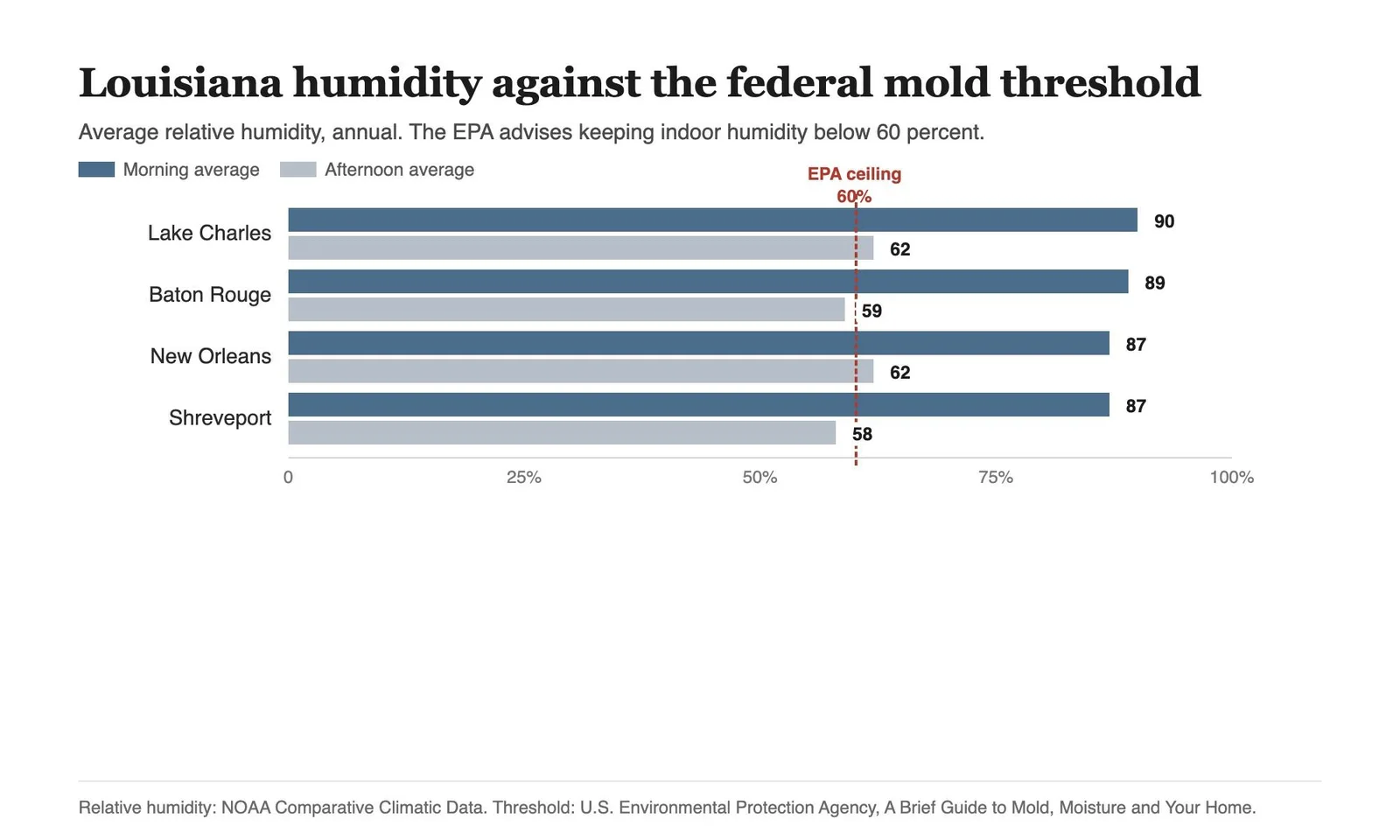
Those are averages, not storm-day peaks. New Orleans runs 87 and 62. Lake Charles is 90 and 62. Shreveport, up in the northwest corner and generally considered the drier part of the state, still averages 87 and 58.
Read that against the EPA figure. The morning average across South Louisiana sits roughly 30 points above the ceiling the EPA identifies, and the afternoon average is at or slightly over it. An unconditioned space in this state does not occasionally exceed the mold threshold. It lives above it, and only dips toward the line in the afternoon.
Why duration is the whole problem
The second half of the EPA guidance explains why this matters for storage specifically rather than for daily life.
The agency’s position is that damp materials dried within 24 to 48 hours will usually not grow mold. That is a useful rule for a spill or a leak, and it is why a wet towel on a bathroom floor is a minor event.
Storage inverts every assumption in that rule. Nothing gets dried. Nothing gets checked. The 24- to 48-hour window that normally protects a household passes on day one and keeps passing every day for the length of the rental.
This is why the damage from humid storage tends to be discovered rather than observed. Nobody watches it happen. Someone opens a container in October and finds out what August did.
What actually goes first
The failure order is fairly consistent, and it is not the order most people would guess.
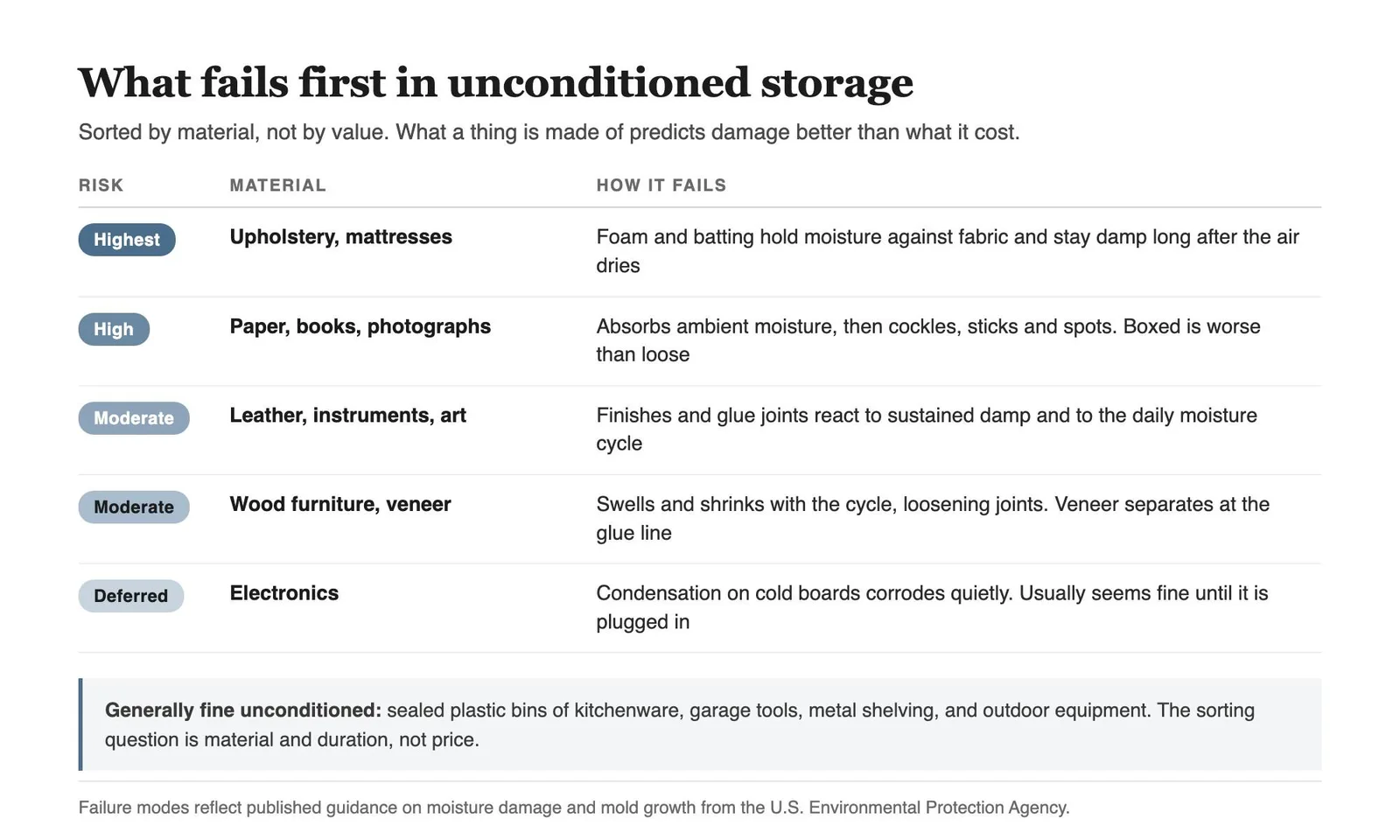
Upholstered furniture and mattresses go first, because foam and batting hold moisture against fabric and stay damp long after the air has dried out. Anything with a fabric surface and a soft core is the most vulnerable thing most people store.
Paper follows. Books, documents, photographs, and artwork on paper absorb ambient moisture, then cockle, stick, and foxing appears. Boxed paper is worse than loose paper, because the box holds humidity around it.
Wood is slower but not immune. Solid wood swells and shrinks with the moisture cycle, loosening joints on furniture assembled in a conditioned house. Veneer and laminate delaminate at the glue line.
Electronics fail quietly. Condensation on a cold circuit board in a warming container causes corrosion, and the device usually seems fine until it is plugged in months later.
Leather, musical instruments, and anything with a finish or a glue joint belong in the same category as the furniture. If a museum would control the humidity around it, a storage container in Louisiana will not treat it kindly.
The genuinely fixable part
This isn’t an argument that everything must go into a climate-controlled unit. Plenty of belongings do not care. Sealed plastic bins of kitchenware, garage tools, metal shelving, and outdoor equipment survive a Louisiana summer in an unconditioned container without complaint.
The practical move is to sort by material rather than by value. The instinct is to protect the expensive items, but the sorting variable that actually predicts damage is what a thing is made of and how long it will sit. A cheap upholstered chair is at more risk than an expensive metal filing cabinet.
Duration is the other axis. Two weeks between closing dates has a different risk profile than a six-month renovation, and a container adequate for the first is a gamble for the second. Anyone comparing portable storage options in Louisiana should ask about conditioning based on how long the container will actually sit, not as an upsell to accept or decline in the abstract.
Cost is a real constraint here, and worth knowing before the conversation starts. Conditioned storage carries a premium, and published monthly ranges for storage containers are the right baseline for judging if a quote is reasonable.
Three questions worth asking
Ask what the container actually does about moisture. Ventilated, conditioned, and sealed are three different things, and vendors sometimes use them loosely. Ventilation exchanges air with the outside, which in Louisiana means exchanging it with air at 89 percent.
Ask where the container sits between pickup and delivery. A unit stored in a conditioned warehouse for the middle four months of a six-month rental is a different product from one that sits on a gravel lot, even where the container itself is identical.
Ask about ground contact and shade. A container on grass in full sun has a bigger daily temperature swing than one on gravel in shade, and that swing drives condensation. Warm humid air meeting a cool surface at night is the mechanism, and reducing the swing reduces the water.
The short version
The humidity joke is accurate. The number behind it is 89 percent in the morning, against a published guideline of 60.
That gap does not mean everything you own is at risk. It means you should invert the default assumption. In most of the country, unconditioned storage is fine unless something specific argues otherwise. In Louisiana, unconditioned storage is a decision, and you need to make it on purpose, item by item, with the length of the rental in front of you.