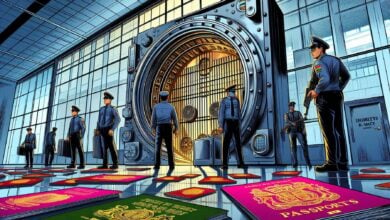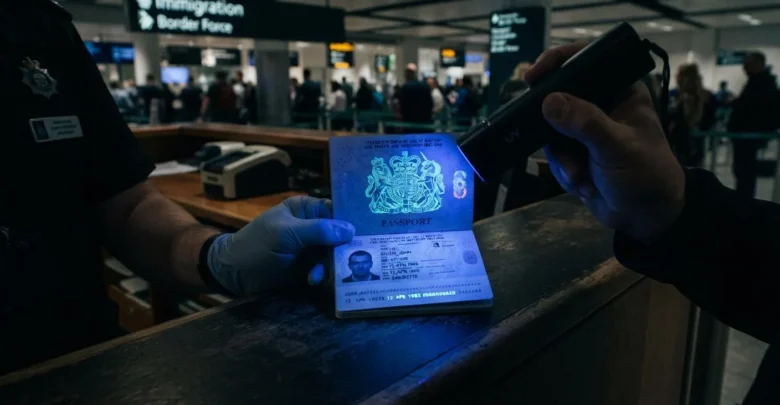
Fluorescent artwork, embedded fibers and specialized inks provide additional features for inspectors to examine.
WASHINGTON, DC, October 12, 2026 — Modern passports contain extensive security technology that remains invisible under ordinary lighting because governments use ultraviolet-reactive inks, fluorescent fibers, hidden artwork, and other specialized materials that become visible only when inspectors examine the document under carefully controlled ultraviolet illumination.
These features give border officers and forensic document examiners an additional layer of evidence because a passport that looks convincing in normal light may reveal missing, misplaced, incorrectly colored, or poorly reproduced security features under ultraviolet light.
Why Ultraviolet Security Features Matter
Ultraviolet inspection works especially well because authentic passport materials can be engineered to produce predictable fluorescent responses, while ordinary commercial paper, toner, inks, laminates, and adhesives often react differently from the specialized materials used during legitimate government production.
Many passport security features are intentionally designed to remain subtle during ordinary use, allowing governments to hide complex visual information within backgrounds, page fibers, seals, symbols, and personalized areas without interfering with the document’s normal readability or appearance.
Specialized Inks Reveal Hidden Designs
When ultraviolet light illuminates the page, certain inks absorb invisible radiation and emit visible light, causing hidden artwork, text, numbers, symbols, or patterns to appear in colors that would otherwise remain invisible under standard white illumination.
Because those fluorescent responses depend on the chemical properties of the inks and materials, a counterfeiter cannot necessarily reproduce them accurately merely by copying the visible design with an ordinary printer, scanner, or commercial image-processing system.
Embedded Fibers Add Security Within the Paper
Security paper may also contain fibers that fluoresce under ultraviolet light, providing another manufacturing characteristic that examiners can compare with trusted specimens from the same passport series, issuing period, and document generation during a professional inspection.
These fibers can appear as short, glowing strands distributed throughout the page, and their color, density, length, placement, and overall behavior may help examiners determine whether the underlying paper matches the material expected in an authentic passport.
A counterfeit page printed on ordinary commercial paper may show a different ultraviolet response because many everyday papers contain optical brighteners that fluoresce broadly, whereas purpose-built security paper can be manufactured to suppress background fluorescence and emphasize selected features.
Hidden Artwork Can Cover Entire Pages
Governments can also print hidden fluorescent images that remain inconspicuous in daylight but become visible under ultraviolet illumination, allowing inspectors to examine national emblems, geometric patterns, page numbers, symbols, or other imagery integrated into the booklet’s security design.
The European Union’s PRADO reference system provides examples of authentic identity and travel documents with ultraviolet-visible patterns, fibers, and other security features, illustrating why professional examiners compare questioned documents against trusted references rather than relying on memory alone.
Ultraviolet Patterns Can Protect Identity Fields
Examiners can place ultraviolet elements around sensitive identity fields, photographs, or document numbers so unauthorized alteration risks disturbing not only the visible information but also the hidden fluorescent structures around the modified area, creating inconsistencies that invite closer inspection.
If someone attempts to remove, replace, scrape, chemically treat, or cover part of a passport page, the surrounding ultraviolet pattern can become interrupted, discolored, unusually bright, unusually dark, or otherwise inconsistent with the rest of the document.
Visa Pages Can Contain Their Own Hidden Features
Visa pages may also contain fluorescent inks, fibers, page numbers, or repeating images, allowing examiners to assess whether individual pages belong to the original booklet rather than having been inserted, reconstructed, or replaced after legitimate government production.
Different wavelengths of ultraviolet light can reveal different security responses, and professional document examiners may use controlled inspection equipment rather than inexpensive decorative lamps, because wavelength, intensity, filters, ambient lighting, and imaging conditions can materially affect what becomes visible.
Different Passport Generations Behave Differently
The exact response depends on the issuing country, passport generation, and materials used, which means inspectors should compare a questioned document with authoritative information for the correct model rather than assuming every genuine passport should display identical fluorescent colors or patterns.
The International Civil Aviation Organization provides the broader international framework for machine-readable travel documents, while individual issuing authorities determine the particular combination of visible, ultraviolet, tactile, optical, and electronic protections incorporated into each passport generation they produce.
Ultraviolet Light Can Reveal Alteration
Ultraviolet examination can also reveal unauthorized overprinting or chemical alteration because added toner, ink, adhesive, correction material, cleaning products, or solvents may fluoresce differently from the original page and create unexpected patches, residues, or disruptions under controlled illumination.
Although such anomalies can provide important investigative clues, one unusual ultraviolet response should not automatically be treated as conclusive proof of fraud because wear, contamination, environmental exposure, manufacturing variation, and accidental damage can also change how materials appear.
Consumer UV Lamps Have Important Limitations
Consumer ultraviolet lamps can reveal some passport features, but they can’t replicate the controlled lighting, magnification, filters, reference databases, imaging systems, and professional experience available in dedicated border or forensic examination environments, making home inspection inherently more limited.
Photographs face similar limitations because cameras can automatically adjust exposure, white balance, contrast, saturation, and image processing when recording ultraviolet-induced fluorescence, so two photographs of the same genuine passport can look noticeably different even under similar lighting conditions.
This limitation matters most when someone tries to prove or disprove passport authenticity using ultraviolet photographs alone, because the image cannot fully show wavelength-specific behavior, paper composition, tactile characteristics, material structure, or other physical properties visible during direct examination.
Ultraviolet Security Complements the Passport Chip
Ultraviolet security also complements electronic passport technology because the chip and physical booklet address different vulnerabilities, meaning a functioning contactless chip cannot independently establish that every page, printed feature, fluorescent element, or physical component remains authentic and unaltered.
Likewise, correct ultraviolet features cannot establish whether electronically stored information carries a valid digital signature, whether government systems still recognize the passport as valid, or whether the person presenting the document is the legitimate holder named by the issuer.
Strong document examination therefore depends on agreement among physical, optical, electronic, biometric, and governmental evidence, rather than treating one fluorescent image, successful NFC scan, holographic effect, or microscopic feature as sufficient proof of comprehensive passport authenticity.
Hidden Features Support a Broader Security System
At Amicus International Consulting, understanding these distinctions helps readers recognize why modern passport authentication requires more than a visual inspection or successful chip read, particularly when lawful government issuance must be distinguished from superficial technical appearance or