A polycarbonate data page and optical features show how passport designers integrate identity safeguards into the booklet’s appearance.
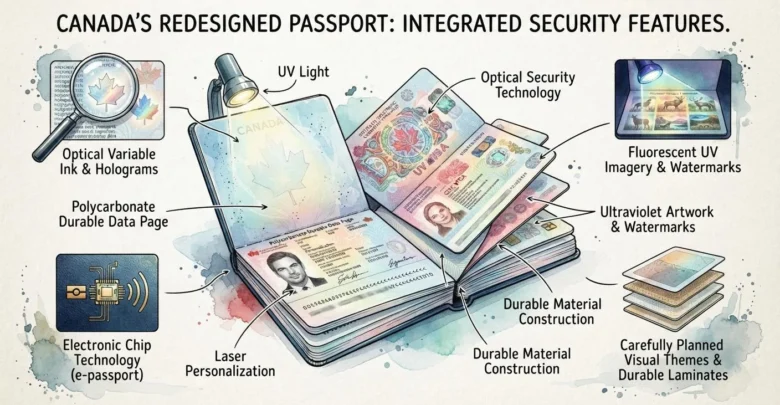
WASHINGTON, DC, October 16, 2026 — Canada’s redesigned passport shows how modern travel documents increasingly combine durable materials, laser personalization, optical technology, electronic components, ultraviolet artwork, and carefully planned visual themes, integrating security features throughout the booklet rather than concentrating them on a single identity page.
The Canadian government unveiled the redesigned passport on May 10, 2023, and gradually introduced the new booklet afterward, replacing the previous generation with a design that incorporates a polycarbonate personal-information page, laser-engraved data, multiple portraits, optical features, and redesigned seasonal artwork.
The Polycarbonate Data Page Changes the Passport’s Construction
One of the most important changes is the personal-information page, which is made of polycarbonate rather than the more conventional construction used in earlier Canadian passports, creating a durable platform that can support several integrated security technologies.
Polycarbonate consists of multiple thin layers that manufacturers permanently fuse together, allowing them to incorporate personalized information and security elements into the physical structure rather than relying entirely on ink printed on an exposed surface.
Canada’s official new passport security overview explains that the polycarbonate personal-information page improves durability while reducing vulnerability to water damage, rough handling, counterfeiting, and unauthorized alteration during the document’s normal period of use.
Laser Engraving Integrates Personal Information
The redesigned passport uses laser engraving for personal information rather than relying exclusively on conventional ink printing, allowing names, photographs, document details, and related personalization to become physically integrated within the polycarbonate structure during secure government production.
This manufacturing approach makes unauthorized alteration more difficult because changing information can require physical interference with the page itself, potentially affecting surrounding layers, engraving characteristics, transparency, surface texture, or other security elements incorporated into the original structure.
Laser engraving therefore provides both resistance and tamper evidence because an attacker trying to remove or replace personalized information must reproduce not only what the data looks like but also how it interacts with the underlying material.
Multiple Portraits Strengthen Identity Comparison
Canada’s redesigned passport includes several representations of the holder’s facial image, giving inspectors more than one personalized feature to compare when determining whether the physical document matches the traveler presenting it.
Repeating the portrait through different technologies creates additional obstacles for identity substitution because anyone attempting to modify the primary photograph must also reproduce secondary personalized images while maintaining their expected appearance, positioning, optical behavior, and relationship with surrounding features.
This redundancy illustrates a broader principle in secure-document design: important identity information appears through several independent mechanisms, so altering one element can create inconsistencies elsewhere in the document.
A Kinegram Adds Dynamic Optical Security
The personal-information page includes a Kinegram that changes appearance when viewed from different angles, creating movement and color effects that provide inspectors with dynamic security information rather than relying exclusively upon static printed graphics.
A conventional scanner or printer may reproduce one photographed appearance of an optical device, yet accurately duplicating the genuine feature’s changing movement, color transitions, image behavior, and structural relationship is a much harder technical challenge.
This type of optical security lets inspectors quickly examine the document by tilting it under suitable lighting and observing whether the feature behaves as expected from the authentic passport.
A Secondary Image Appears Through a Specialized Lens
Canada’s redesigned personal-information page also includes a secondary portrait and date-of-birth information that appear and disappear depending on the viewing angle, adding another personalized optical characteristic directly connected to the passport holder.
Because this feature behaves differently as the document moves, its security value depends partly on controlled optical performance rather than merely on the presence of a photograph or number in the correct location.
An imitation might reproduce what the feature looks like from one angle but fail to duplicate the expected transition when an inspector rotates the passport during examination.
Temperature-Sensitive Ink Creates Another Physical Check
The redesigned passport includes a red maple leaf on the personal-information page that reacts to heat, showing how Canadian designers incorporated a material response that inspectors can examine independently of electronic or optical authentication.
When a finger’s warmth is applied, the feature changes temporarily, giving inspectors another physical characteristic whose expected behavior depends on specialized material properties rather than conventional printing alone.
This responsive feature expands the number of independent manufacturing characteristics a sophisticated counterfeit would need to reproduce convincingly to survive closer inspection.
Color-Shifting Ink Adds Movement to the Design
Another feature uses magnetized color-shifting ink in a deer-and-snowflake design, creating a visual response that changes when the passport is tilted and giving trained inspectors an additional angle-dependent characteristic to examine.
Color-shifting elements matter because ordinary printed gradients can imitate general colors but usually cannot reproduce the controlled movement, reflectivity, and directional behavior produced by specialized optically variable materials.
The resulting effect makes security part of the artwork itself, turning a decorative image into a practical authentication feature that performs differently under changing viewing conditions.
The Chip and Antenna Are Incorporated Into the New Design
Canada’s passport remains an electronic passport with a contactless chip, but the redesigned booklet makes the chip and antenna part of a broader physical security architecture that links electronic identity information to the surrounding document structure.
The Canadian government says the electronic chip is embedded in a transparent window on the first page, adding a feature that can help reveal tampering while allowing the passport’s electronic and physical technologies to coexist in an integrated design.
Information stored electronically includes standardized identity data and the holder’s facial image, while electronic protections allow compatible border equipment to evaluate information that complements what inspectors can see on the physical page.
Artwork Is Part of the Security Architecture
The redesign replaced earlier imagery with new scenes inspired by Canada’s landscapes, wildlife, communities, and four seasons, creating distinctive artwork that changes throughout the booklet while also supporting security features embedded within the page designs.
Spring, summer, autumn, and winter imagery gives each section a recognizable visual identity, but the illustrations do more than decorate because intricate backgrounds and security printing make faithful reproduction harder.
The relationship between artwork and security shows how passport designers increasingly avoid treating technical protections as separate additions, instead weaving them into the document’s visual language.
Ultraviolet Light Transforms the Visa Pages
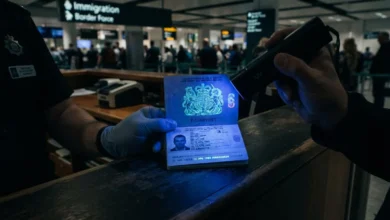
Under ordinary illumination, the visa pages display seasonal scenes and recognizable Canadian imagery, while ultraviolet examination reveals additional colors, patterns, and hidden elements that substantially change the appearance of those same pages.
This transformation gives trained examiners another independent way to compare a questioned passport with trusted examples, because counterfeit printing that looks convincing in daylight can behave incorrectly when exposed to controlled ultraviolet illumination.
The technique also lets substantial security information remain unobtrusive during everyday use, preserving readable visa pages while giving border authorities an additional examination mode when closer inspection is needed.
Security Features Work Across Different Lighting Conditions
A sophisticated passport should not necessarily appear identical under daylight, ultraviolet illumination, transmitted light, and changing viewing angles, because designers intentionally use materials whose appearance depends on how inspectors examine them.
Canada’s redesigned document reflects this approach by combining features that respond to angle, heat, ultraviolet light, optical lenses, and electronic readers, thereby creating several separate inspection environments within the same physical booklet.
A counterfeit that can imitate one condition must therefore remain convincing under several others, making it harder to reproduce the passport consistently across all expected forms of examination.
Durability Supports Identity Protection
The move to polycarbonate also addresses the practical reality that passports must remain usable through years of international travel, frequent inspection, humidity, luggage pressure, repeated opening, and exposure to changing environmental conditions.
A more durable personal-information page helps preserve key identity details and security features while reducing the likelihood that everyday wear will damage the characteristics inspectors need to evaluate the document.
Durability therefore supports identity protection because a stable document keeps legitimate information readable and makes unusual structural damage easier to distinguish from normal deterioration.
The Redesigned Passport Reflects International Standards
Although countries select their own artwork and many specific security technologies, electronic passports operate within an international environment shaped by ICAO machine-readable travel document standards, which establish common technical principles that support interoperability and secure inspection across international borders.
Canada’s redesign follows that broader framework while using distinctive national artwork and its own combination of materials, optical devices, laser personalization, and electronic technology to create a passport recognizable as uniquely Canadian.
This balance between international standardization and national design allows border systems to process passports consistently while still giving issuing governments substantial flexibility in how they protect their documents against counterfeiting and alteration.
Older Canadian Passports Can Still Be Legitimate
A redesigned passport does not mean every older Canadian passport automatically became invalid when the new generation entered circulation, because previously issued documents can remain legitimate until expiration unless another circumstance affects their validity.
This overlap means border officers may encounter different generations of Canadian passports at the same time, requiring examiners to identify the appropriate model before deciding which security features, page designs, materials, or optical characteristics should be present.
Comparing an older authentic passport against the newest security specifications without considering its generation could therefore lead to misleading conclusions about features introduced only during the redesign.
Physical Security Still Matters in an Electronic Passport
A contactless chip does not make sophisticated physical security unnecessary because electronic verification addresses different risks than substituted pages, reconstructed data areas, altered printing, damaged booklet components, or fraudulent physical reproduction.
Canada’s design combines electronic identity data with polycarbonate construction, laser engraving, optical features, ultraviolet artwork, and tactile and responsive elements, giving inspectors several independent ways to spot inconsistencies.
This approach shows why modern passport security still invests heavily in physical manufacturing even as automated border systems become increasingly dependent on electronics, biometrics, and cryptographic verification.
A Successful Chip Read Does Not Replace Physical Examination
A functioning chip can provide important electronic information, yet it cannot independently establish that every visual, optical, or structural characteristic elsewhere in the booklet remains intact and consistent with legitimate government production.
An inspector can therefore evaluate whether the electronic data corresponds with the laser-engraved page while separately examining optical devices, page artwork, ultraviolet features, booklet construction, and other physical characteristics.
The system’s strength comes from agreement among these different sources, not from assuming that successful electronic communication automatically proves every component of the passport authentic.
Photographs Cannot Demonstrate Every Security Feature
A digital photograph can reproduce the general appearance of Canada’s redesigned passport but cannot fully demonstrate movement within the Kinegram, temperature-sensitive behavior, tactile structure, ultraviolet transformation, transparency, or the physical qualities of polycarbonate construction.
Camera processing can also change color, contrast, reflections, and optical effects, so a genuine feature may look unusual in a JPEG, while a counterfeit feature can look more convincing than it would under direct physical examination.
Remote photographs therefore provide useful visual information while remaining fundamentally different from inspecting the original document under multiple lighting conditions and interacting directly with its physical and electronic technologies.
Distinctive Artwork Creates More Than National Identity
Passport artwork traditionally reflects national identity, yet the Canadian redesign demonstrates how visual storytelling can also support document protection by placing technically demanding designs throughout pages that inspectors can compare against trusted authentic examples.
Seasonal scenes, animals, landscapes, maple-leaf motifs, and complex backgrounds help create a recognizable document while also increasing the structured visual information that unauthorized reproductions must imitate accurately.
Security design therefore integrates with cultural design, allowing the passport to communicate national imagery while meeting the practical requirements of international identity verification.
The Cover Also Became Part of the Redesign
Canada introduced a redesigned cover featuring a new maple-leaf treatment and additional physical details, showing that the government approached the project as a booklet-wide redesign rather than simply replacing the personal-information page.
Security extends throughout a passport because the cover, binding, visa pages, data page, chip, artwork, and printing should collectively correspond with the same legitimate document generation.
A convincing identity page placed inside an otherwise inconsistent booklet would therefore remain vulnerable to detection when inspectors evaluate the passport as one integrated physical object.
Multiple Security Technologies Increase Reproduction Difficulty
A sophisticated counterfeiter might reproduce one optical feature or create a visually convincing imitation of polycarbonate, but reproducing every material, electronic, optical, printed, and responsive characteristic simultaneously presents a substantially greater challenge.
This principle explains why modern passports contain numerous apparently unrelated technologies: each provides another opportunity for an inconsistency to emerge under professional examination.
Rather than depending upon one supposedly impossible-to-copy feature, effective security distributes protection across several independent systems whose combined behavior becomes substantially harder to imitate.
Manufacturing Quality Becomes Evidence
Modern passport examination increasingly requires inspectors to understand not only what features should appear but also how those features should have been manufactured, aligned, personalized, and integrated within the document.
Laser engraving behaves in characteristic ways, polycarbonate has specific structural qualities, optical devices move in particular ways, ultraviolet inks respond under specific illumination, and booklet components should remain internally consistent with their expected production process.
A counterfeit can therefore include all the right feature names yet remain detectable when the quality and interaction of those features don’t match authentic manufacturing.
The Canadian Passport Shows Security Through Integration
Canada’s redesigned passport is especially notable because it integrates many security technologies directly into visible artwork, personalized structures, transparent elements, and page materials, rather than presenting them as isolated technical additions disconnected from the booklet’s overall appearance.
Through Amicus International Consulting’s passport security resource, readers can examine how these physical technologies fit alongside electronic chips, digital signatures, machine-readable information, and biometric verification within the broader architecture of contemporary travel-document protection.
This integration makes the redesigned passport a useful example of how governments can strengthen identity protection while producing a visually distinctive national document whose artistic and security objectives reinforce one another.
Security and Design Now Work Together
Canada’s redesigned passport shows that modern document security no longer needs to exist separately from visual design, because polycarbonate construction, laser engraving, optical devices, responsive inks, ultraviolet artwork, and electronic technology can all integrate into a coherent booklet.
The resulting document gives inspectors numerous ways to examine authenticity while presenting travelers with imagery centered on Canadian landscapes, seasons, wildlife, and national symbols, rather than hiding every security technology behind purely technical graphics.
By combining durable materials with distinctive artwork and layered optical protections, Canada’s passport shows how contemporary identity documents increasingly treat the entire booklet as a coordinated security system rather than relying primarily on a single protected photograph or electronic chip.