Global Neonatal Respiratory Care Devices Market to Reach USD 3.10 Billion by 2032, Driven by Rising Adoption of Non-Invasive Ventilation and AI Integration

Neonatal Respiratory Care Devices Market Overview
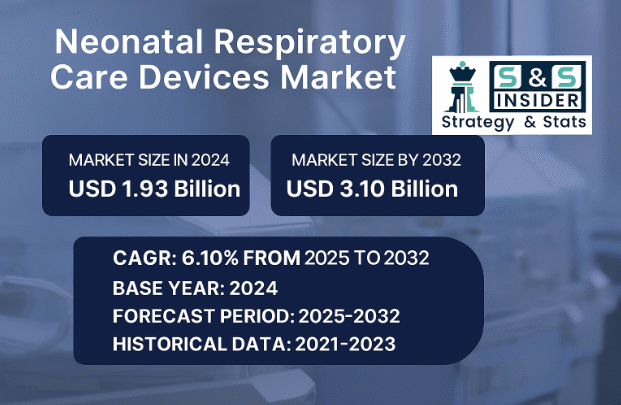
The Neonatal Respiratory Care Devices Market plays a crucial role in supporting the respiratory needs of newborns, especially premature infants with underdeveloped lungs. As neonatal intensive care units (NICUs) evolve toward precision medicine and data-driven monitoring, the demand for innovative respiratory care solutions continues to rise. In 2024, the market was valued at USD 1.93 billion and is projected to reach USD 3.10 billion by 2032, growing at a CAGR of 6.10% between 2025 and 2032.
This growth is fueled by technological advancements, rising neonatal morbidity rates, and a global push toward improving neonatal healthcare infrastructure. Increasing prevalence of respiratory distress syndrome (RDS) and bronchopulmonary dysplasia (BPD) among preterm infants has intensified the need for efficient respiratory care solutions.
Key Market Trends Transforming Neonatal Care
The global neonatal respiratory care landscape is witnessing a paradigm shift, driven by non-invasive and intelligent respiratory technologies. Non-invasive ventilation (NIV) methods such as Continuous Positive Airway Pressure (CPAP) and High-Flow Nasal Cannula (HFNC) are increasingly replacing invasive ventilation to minimize lung injury and enhance patient outcomes. These approaches offer safer, gentler respiratory support tailored to the fragile physiology of neonates.
Another major trend is the integration of artificial intelligence (AI) and machine learning in NICU monitoring systems. AI-enabled algorithms are being developed for real-time assessment of respiratory patterns, enabling clinicians to detect distress or abnormalities earlier. This not only reduces manual monitoring errors but also enhances response time and treatment accuracy.
Moreover, the market is witnessing rising demand for portable and compact respiratory devices, particularly in remote and low-resource settings. These innovations are extending advanced neonatal care beyond hospitals, enabling timely interventions in rural or emergency care setups.
The growing emphasis on infection prevention is driving the shift toward disposable and single-use respiratory interfaces, ensuring hygiene and reducing cross-contamination risks in NICUs. Similarly, wearable biosensors and miniaturized monitoring systems are being increasingly adopted for continuous, non-invasive assessment of neonatal respiratory function — providing clinicians with actionable insights while minimizing infant discomfort.
Key Drivers and Restraints
The market’s upward trajectory is primarily supported by advancements in neonatal care technology and rising healthcare investments worldwide. Governments and healthcare organizations are prioritizing neonatal survival rates by upgrading NICU facilities, which is positively impacting device adoption. Furthermore, the rising rate of preterm births globally remains one of the most significant growth drivers, with WHO estimating that around 15 million babies are born prematurely each year.
Another major growth factor is the integration of tele-neonatology and remote patient monitoring systems, which enable seamless post-discharge respiratory management and follow-up care. These digital advancements are transforming neonatal healthcare delivery by bridging the gap between hospitals and home-based care.
However, the market faces challenges such as high equipment costs, particularly in developing economies where healthcare budgets are limited. Additionally, the lack of trained neonatal care specialists and inconsistent regulatory standards across regions pose obstacles to rapid market expansion. Despite these constraints, ongoing product innovation and public-private healthcare collaborations are expected to mitigate these challenges over time.
Opportunities and Challenges Ahead
Opportunities abound in the form of AI-powered predictive analytics, wearable neonatal monitoring technologies, and smart respiratory devices designed for continuous feedback and autonomous adjustments. As the healthcare industry embraces digital transformation, manufacturers are focusing on developing data-driven respiratory systems capable of optimizing oxygen delivery in real time.
Furthermore, there is a growing opportunity in low- and middle-income countries (LMICs) where neonatal mortality remains high due to inadequate respiratory support infrastructure. Strategic collaborations and affordable, portable device innovations are expected to drive greater adoption in these markets.
However, the regulatory complexities surrounding neonatal medical devices can slow down product approvals. Ensuring clinical efficacy and safety compliance across multiple jurisdictions remains a critical challenge for global manufacturers.
Market Segmentation Overview
The Neonatal Respiratory Care Devices Market is segmented based on product type and end-user.
By product type, the market includes devices and accessories & consumables, with devices such as ventilators, CPAP systems, and oxygen delivery units leading in revenue generation. Consumables such as nasal masks, cannulas, and humidifiers are expected to see steady demand growth due to single-use trends in NICUs.
By end user, the market is dominated by hospitals, which account for the majority of NICU admissions globally. However, specialty clinics and home-based neonatal care settings are emerging as key growth areas, supported by portable and wireless respiratory devices.
Regional Insights
The North American market currently leads global revenues, driven by advanced healthcare infrastructure, early adoption of smart respiratory systems, and strong government support for neonatal care programs in the U.S. and Canada.
Europe follows closely, with countries such as Germany, the UK, and France investing heavily in neonatal research and technology upgrades.
The Asia-Pacific region is expected to witness the fastest growth rate during the forecast period, propelled by rising birth rates, improved healthcare access in India and China, and ongoing public health initiatives targeting infant mortality reduction.
Meanwhile, Latin America and the Middle East & Africa represent emerging markets with untapped potential, particularly as awareness around neonatal respiratory care and healthcare investments continue to rise.
Competitive Landscape
The market features several leading players actively developing innovative neonatal respiratory solutions. Key companies include Ambu A/S, Cardinal Health, Koninklijke Philips N.V., Drägerwerk AG & Co. KGaA, Medtronic, GE Healthcare, BD, Vyaire Medical, Natus Medical Incorporated, and Utah Medical Products, Inc.
These firms are emphasizing strategic partnerships, R&D investment, and AI integration to strengthen their market positions. The competitive landscape is becoming increasingly technology-driven, with emphasis on device miniaturization, real-time monitoring, and patient-centric innovation.
Future Outlook
The future of the Neonatal Respiratory Care Devices Market lies in the convergence of smart technology, data analytics, and personalized respiratory support systems. As neonatal care becomes more digital and predictive, device manufacturers are likely to focus on developing adaptive, AI-integrated systems capable of learning from patient data to deliver optimal respiratory support.By 2032, with the market projected to reach USD 3.10 billion, neonatal respiratory care will be at the forefront of technological innovation in pediatric medicine — enhancing infant survival rates and transforming the standard of care globally.