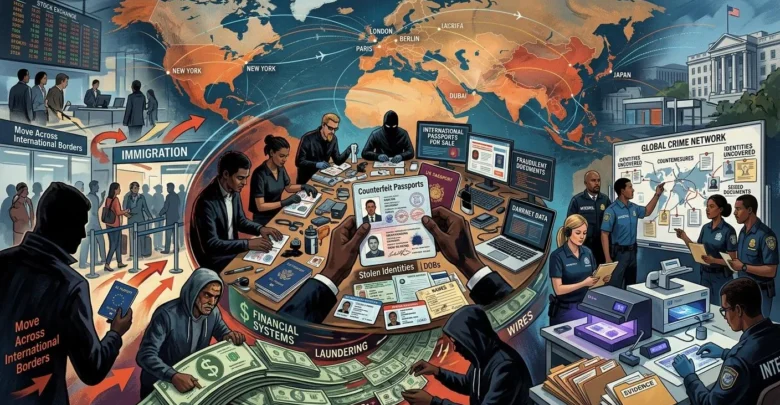
Counterfeit passports, stolen identities, and organized document fraud challenge governments worldwide as criminals exploit official credentials to conceal identities, access financial systems, and move across international borders.
WASHINGTON, DC, November 11, 2026 — The global fight against counterfeit passports is increasingly a struggle over identity itself, as criminal organizations exploit fraudulent travel credentials to conceal personal histories, impersonate legitimate citizens, and undermine the systems governments and businesses rely on to establish trust.
For law enforcement authorities, the threat extends far beyond the production of forged passport booklets because false identities can support financial fraud, organized migrant smuggling and other criminal activities that depend on misleading information about individuals and their backgrounds.
Recent investigations in the United States and Europe show how counterfeit identity documents can provide access to banking services, transportation networks, and commercial relationships, while exposing victims to financial losses and complications from the unauthorized use of personal information.
The central security challenge is determining whether a document is genuine, whether the identity it represents was legitimately established, and whether the person presenting that credential is its rightful holder: three questions that require different but complementary verification methods.
Passport Fraud Challenges the Foundations of Personal Identity
A passport represents an official government certification of identity and nationality, making it one of the most widely recognized credentials for establishing personal information during international travel and in numerous commercial transactions that require reliable identification.
When criminals reproduce, alter or misuse passports, they exploit the confidence that institutions place in government-issued credentials, potentially creating misleading relationships between an individual’s apparent identity and the official records associated with that person.
This vulnerability matters because identity is not established solely by the photograph or name printed inside a booklet, but through a broader system involving birth records, citizenship evidence, government enrollment procedures and secure document production.
Investigators therefore increasingly view passport fraud as an identity-related offense that can overlap with financial deception, impersonation, and organized criminal activity, rather than treating every suspicious credential as an isolated case of counterfeit manufacturing.
Counterfeit Passports Can Support Several Criminal Identities
Fraudulent travel documents may be used to impersonate existing individuals, create misleading personal histories, or support transactions under names that do not match the person presenting identification to a financial institution or government agency.
These offenses involve different circumstances because a fabricated passport containing invented personal details differs from a counterfeit credential displaying another person’s legitimate information, while a genuine document obtained through deception presents another investigative problem.
Understanding these distinctions allows investigators to determine whether an apparent identity was invented, stolen or improperly acquired through a legitimate government process, while identifying the evidence needed to establish responsibility for suspected criminal conduct.
The objective is not merely to recognize an unfamiliar passport design, but to establish whether the credential accurately represents the identity of its presenter and whether the issuing authority actually authorized the document.
American Bank Fraud Cases Demonstrate the Identity Connection
A federal prosecution announced in Mississippi during December 2025 illustrated how counterfeit passport cards can become central to financial deception when criminals use stolen identities to impersonate legitimate customers at regulated banking institutions.
According to the U.S. Department of Justice’s December 23, 2025, announcement, four New York residents received prison sentences for participating in a conspiracy involving false passports, aggravated identity theft and fraudulent withdrawals from financial institutions in Mississippi.
Prosecutors reported that the defendants used stolen personal information to create counterfeit passport cards and credit cards, then presented those credentials in attempts to obtain money from other people’s accounts.
Investigators also connected the stolen information to mail theft committed by another criminal group, demonstrating how separate offenses can become linked through the acquisition, transfer and unauthorized use of personal identity records.
The case illustrates why a counterfeit passport can mean far more than document forgery, potentially linking fraudulent identification to stolen financial information, multiple criminal participants, and victims with no involvement in the offenses.
Identity Theft Victims Can Face Lasting Financial Consequences
People whose personal information is used in counterfeit identification schemes may discover unauthorized banking activity, disputed transactions and inaccurate institutional records, requiring significant effort to establish that they never authorized the criminal transactions conducted under their names.
The resulting harm can extend beyond immediate financial losses because institutions may associate the legitimate identity holder with suspicious activity, complicating efforts to restore account access or correct misleading records.
Effective investigations therefore require authorities to distinguish criminals presenting deceptive documents from innocent individuals whose information appears in those credentials, making victim identification central to the investigative process.
The broader lesson is that protecting passport integrity also means protecting the people whose identifying information appears in official records, especially when criminals exploit that information to create convincing representations of someone else’s identity.
Organized Crime Groups Use False Identities Across Borders
International criminal organizations have also used fraudulent travel credentials to move between countries, creating challenges when investigators must determine whether different names and documents belong to the same suspected criminal participant.
In July 2025, British authorities announced sanctions against suspected people-smuggling organizations, including Balkan criminal groups accused of obtaining counterfeit passports and moving associates across international borders under false identities.
As Reuters reported in its July 23, 2025, coverage, Britain targeted 24 individuals and one company, including eight people from the Balkans accused of supplying fraudulent travel documents to criminal organizations involved in cross-border activity.
The sanctions also targeted suspected financial intermediaries and transportation-related businesses, showing how identity fraud can become part of an organized criminal infrastructure that extends beyond individuals who personally manufacture or present counterfeit passports.
These allegations show why international investigators examine relationships among suspected document suppliers, criminal associates, and financial transactions, while recognizing that sanctions designations are legally distinct from criminal convictions that establish guilt.
Passport Fraud Can Conceal Criminal Histories
An individual using deceptive identification may attempt to create distance between their current activities and an earlier identity associated with criminal investigations, immigration proceedings or other legally significant records maintained by government authorities.
However, a fraudulent passport does not erase existing convictions, invalidate arrest warrants or establish lawful entry rights, and authorities must investigate the actual circumstances before concluding that someone deliberately attempted to avoid prosecution.
A genuine passport can also be presented improperly by an impostor, creating a separate problem because its physical construction and electronic information may remain authentic even though the person carrying it has no authority to do so.
For investigators, determining the relationship between a person and the document presented can therefore be more important than identifying whether the booklet contains sophisticated printing or convincing protective features.
Border Security Depends on Reliable Identity Records
Governments establish passport identities through application procedures involving citizenship evidence and personal records, making the reliability of those original records essential to the integrity of every document subsequently issued to an eligible applicant.
When an applicant provides fraudulent supporting information, an authentic government-issued passport may still contain improperly accepted identity details, creating risks that ordinary physical inspection or electronic signature validation may not detect.
Secure enrollment procedures, reliable civil records and appropriate examination of supporting documents consequently remain important safeguards alongside advanced passport designs, particularly when authorities investigate suspected impersonation during the original application process.
The distinction demonstrates why counterfeit manufacturing and fraudulent issuance require different responses, even though both can result in documents used to misrepresent an individual’s identity during international travel or financial transactions.
Modern Passport Technology Helps Establish Authenticity
Contemporary passports incorporate security printing, protected identity pages and electronic components intended to make unauthorized reproduction more difficult, providing trained inspectors with multiple opportunities to examine whether a document corresponds with its claimed issuing authority.
As explained in Amicus International Consulting’s examination of modern passport security and counterfeit detection, physical document examination, electronic authentication and biometric identity comparison serve different purposes, making their combined interpretation more informative than reliance on any single visible feature.
Polycarbonate identity pages and laser engraving can strengthen resistance to certain physical alterations, while specialized optical elements and ultraviolet security features help inspectors identify inconsistencies when comparing questioned credentials with appropriate authentic reference documents.
These safeguards do not, on their own, establish that every document was lawfully obtained or that its presenter is the rightful holder, so officials must verify identity when they encounter suspicious personal information or inconsistent records.
Electronic Passport Chips Strengthen Digital Trust
Electronic passports contain contactless chips storing protected identity information, including digitally signed data that compatible inspection systems can evaluate using appropriate government certificates to assess authenticity and detect certain unauthorized changes.
Passive Authentication helps establish whether protected information corresponds with data signed by an authorized issuing authority, providing evidence of electronic integrity that cannot be established by merely examining a photograph of a passport.
However, successfully reading information from a chip is not the same as validating its digital signatures, and even a successful authentication result cannot independently establish that the credential remains valid or belongs to its presenter.
This distinction matters when evaluating claims about counterfeit passports because a standard smartphone app showing personal details does not necessarily provide the same assurance as a properly configured professional authentication system.
Biometric Screening Helps Connect People With Their Records
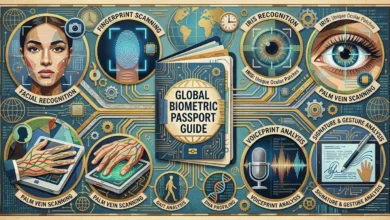
Facial recognition and fingerprint verification can strengthen identity examinations by comparing individuals with trusted government records, potentially identifying situations where a person presents different names or another individual’s authentic travel credential.
Such comparisons address risks that ordinary passport printing and electronic signatures cannot resolve on their own, because a genuine document may still be improperly used by someone whose identity does not match the authorized holder.
Biometric technology nevertheless requires appropriate safeguards because image quality, technical limitations and inaccurate reference information can produce uncertain results, making trained human review important before authorities reach consequential conclusions about suspected fraud.
A biometric match can provide evidence connecting separate records, but it does not independently establish criminal intent, immigration eligibility or whether an individual deliberately concealed information during an earlier government encounter.
Digital Identity Fraud Extends Beyond International Travel
The expansion of remote customer identification has created additional challenges because financial institutions and commercial services may receive passport photographs electronically, without the ability to inspect physical security features or independently authenticate protected chip information.
Criminals can exploit weaknesses in these processes by presenting altered identity images or stolen personal details, creating risks that differ from those associated with a counterfeit passport physically examined at an airport.
Organizations must therefore understand the capabilities of their verification systems, recognizing that a successful visual comparison or automated document review does not necessarily establish government issuance, rightful possession or the accuracy of underlying identity records.
The growing reliance on digital identification makes careful data protection equally important, since unauthorized disclosure of passport information can enable impersonation even when criminals cannot reproduce the document’s electronic security features.
International Cooperation Strengthens Identity Investigations
Cross-border identity fraud frequently requires cooperation among national authorities because suspected offenders, financial accounts and document suppliers may operate in different jurisdictions, while relevant evidence is distributed among agencies with separate legal responsibilities.
Information sharing can help investigators identify connections among suspected offenses, provided findings are supported by reliable records and transmitted under legal safeguards that protect sensitive personal information.
International passport authentication standards also support cooperation by allowing compatible systems to examine electronically protected credentials issued by foreign governments, helping establish trust without requiring every country to maintain identical national identity databases.
These capabilities become increasingly important as legitimate international mobility expands, requiring authorities to distinguish lawful travel and dual citizenship from deliberate document deception without treating unfamiliar identities as inherently suspicious.
Legitimate Identity Changes Must Remain Distinct From Fraud
Lawful name changes, multiple citizenships and government-issued second passports are fundamentally different from counterfeit identities because they originate through recognized legal procedures and remain subject to official documentation and verification requirements.
An individual may hold more than one legitimate nationality or use a newly authorized legal name without committing fraud, so investigators must establish deliberate misrepresentation rather than infer criminality from ordinary documentary differences.
Maintaining this distinction helps protect legitimate travelers while allowing law enforcement agencies to concentrate resources on verified identity theft, forged credentials and fraudulent applications supported by reliable investigative evidence.
The Future of Passport Security Depends on Identity Integrity
The ongoing threat of counterfeit passports shows why document security must extend beyond attractive printing and sophisticated electronics to include trustworthy issuance records, accurate government information, and reliable ways to confirm a credential’s rightful holder.
For investigators, the most effective response combines modern authentication technology with coordinated financial investigations, international cooperation and appropriate protection for people whose personal information has been stolen or misused.
Ultimately, the battle against counterfeit passports is a battle to preserve confidence in identity itself, ensuring that governments, financial institutions and international travelers can rely on authentic credentials without confusing technological sophistication with complete protection against fraud.