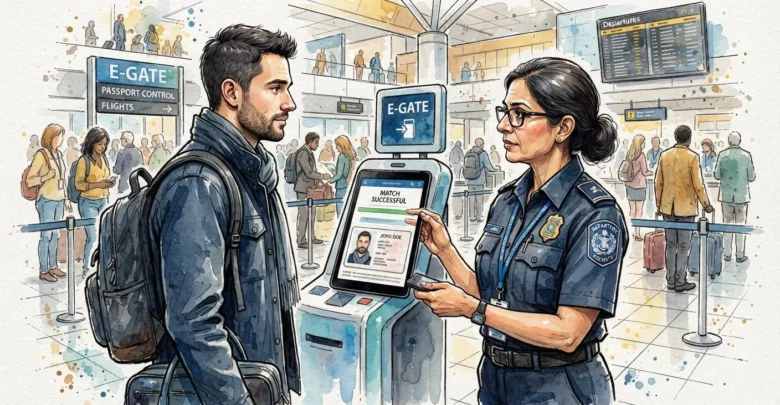
Clearing information from a terminal and removing records from central systems are separate data management processes, meaning a photograph can disappear from an airport device while another authorized copy remains within a government border, immigration or security system under a different retention policy.
WASHINGTON, DC, October 23, 2026, When an automated airport eGate completes a facial comparison and removes the traveler’s photograph from the equipment operating at the checkpoint, that local deletion should not automatically be interpreted as proof that every government copy, transaction record or derived biometric record associated with the encounter has also disappeared.
An eGate Is Usually Only One Part of a Larger System
An automated border gate may appear self-contained because travelers insert or scan a passport, look toward a camera, and receive an immediate instruction to proceed or seek assistance, yet the equipment can operate as one endpoint within a much larger government information infrastructure.
The terminal can temporarily collect passport data and a newly captured photograph before transmitting the information through secure networks to centralized services that perform document checks, facial comparisons, immigration queries, or transaction recording, depending on the architecture selected by the responsible border authority.
Once information leaves the terminal, deleting the temporary copy stored on that device does not necessarily affect information already received by another authorized system, because separate computers can maintain separate copies governed by independent technical and legal retention requirements.
This distinction resembles many modern networked services in which information displayed or processed on one device represents only one copy within a broader transaction, although government border systems generally operate under considerably more specialized security, auditing and statutory requirements.
Local Storage Can Be Temporary by Design
Border equipment does not necessarily need to retain every image indefinitely because the local terminal may require the photograph only long enough to complete image-quality checks, prepare the facial comparison and receive a decision from the government systems supporting the inspection.
After those immediate functions conclude, software can remove temporary files from the checkpoint device according to predefined security policies, reducing unnecessary accumulation of highly sensitive biometric information on equipment physically installed within a busy transportation environment.
This approach can benefit cybersecurity because minimizing unnecessary local data reduces the sensitive information potentially exposed if a terminal is damaged, improperly accessed, or removed from service without adequate data-handling controls.
However, local minimization should not be confused with system-wide deletion, because information transmitted elsewhere before the temporary file was cleared can remain available wherever another legally authorized component has its own reason and authority for retaining it.
Central Government Systems Serve Different Purposes
A centralized border system can receive information from thousands of inspection terminals across airports, land crossings, and maritime facilities, allowing authorities to maintain consistent immigration records without relying on each individual checkpoint device as the permanent repository.
The information stored centrally can support purposes extending beyond the few seconds required for facial comparison, including documenting an entry or departure, recording the completion of identity verification, supporting immigration history or preserving information associated with a referral requiring additional examination.
Whether the actual facial photograph remains within that central environment depends upon the government’s legal authorities and system design, because some programs retain only limited transaction information while others retain biometric images as part of a broader immigration record.
For that reason, travelers seeking to understand retention should identify which government system receives the image rather than focusing exclusively on what happens inside the visible airport terminal immediately after the gate opens.
Deletion Commands Do Not Automatically Propagate Everywhere
In a networked architecture, deleting a file from one computer does not inherently instruct every connected system to erase every corresponding copy, because those other systems may use different databases, identifiers, retention schedules, and legal authorities governing the information they maintain.
A local terminal can therefore clear its working directory while a central biometric service retains the image for another defined period, and an immigration transaction system can separately preserve information documenting the traveler’s crossing without retaining the original camera photograph at all.
True system-wide deletion requires an architecture that can identify all relevant copies and apply the appropriate deletion instructions across repositories, which can become considerably more complicated when information exists in operational databases, audit records, backup systems, and legally required archives.
Government agencies generally establish specific record-management procedures precisely because deleting sensitive information involves more than removing a visible file from the device where someone first encountered or entered that information.
Temporary Processing Copies and Official Records Are Different
A photograph captured by an eGate can exist temporarily as a processing file before the government determines whether any version of that image belongs within an official immigration, biometric or border-crossing record maintained after the immediate transaction.
The temporary processing copy may show the same face as a centrally stored image, but the two files can have different legal significance because one exists only to complete computation while the other becomes part of a government record.
This distinction matters when agencies publish statements explaining that they delete photographs from certain systems within a particular period, because travelers need to understand precisely which copy and which information system the policy describes.
The United States Customs and Border Protection biometric travel program provides public information describing how facial comparison supports entry and departure processing, while applying different retention treatment depending upon citizenship, traveler category and the government purpose associated with the particular biometric transaction.
A Border Transaction Can Outlive the Photograph
Even if a government quickly deletes the newly captured facial image, it can still maintain records showing that a traveler crossed a border at a particular time and location because travel history is a different category of information from the photograph used to verify identity.
The retained record might contain the person’s biographical details, passport number, flight information, inspection location, date of entry or departure, and the outcome of processing without preserving every photographic frame originally collected by the eGate camera.
This separation allows authorities to minimize biometric information while still maintaining the immigration records needed to administer lawful entry periods, identify overstays, confirm departures, and reconstruct travel histories when authorized governmental purposes require that information.
Consequently, deleting a photograph should never be assumed to delete the entire border encounter, because the government may have independent legal reasons to preserve non-photographic information associated with the same crossing.
Facial Templates Create Another Layer of Complexity
Modern facial recognition does not ordinarily compare photographs as simple arrays of pixels because software analyzes facial characteristics and converts relevant information into a mathematical representation that can be compared against another representation generated from the reference portrait.
Depending on the system, that mathematical representation may exist only temporarily during the comparison or remain subject to its own retention controls, creating another category of information that travelers may not see even when the original photograph disappears from a user-facing interface.
Deleting the source image therefore does not logically establish whether a derived biometric representation has also been removed, because the two pieces of information can exist independently once the algorithm has generated the representation required for matching.
Public privacy documentation matters here because meaningful disclosure should explain how photographs and derived biometric information are handled, rather than leaving travelers to assume all data created during facial recognition follows the same lifecycle.
Backup Systems Can Delay Complete Physical Erasure
Large government information systems typically use backup and disaster-recovery procedures intended to prevent catastrophic data loss when hardware fails, software becomes corrupted or another event damages primary operational databases containing important governmental records.
When information is deleted from the active database, copies contained within existing backups may remain physically present until those backups reach the end of their scheduled lifecycle, even though ordinary users and operational systems can no longer retrieve the deleted record through normal procedures.
This does not necessarily mean the agency continues using the supposedly deleted biometric information, because backup environments can be tightly controlled and intended solely for restoration during exceptional circumstances rather than ordinary searching or border processing.
However, the distinction shows why technical deletion can happen in stages: information first disappears from active operational systems and later ages out of archival or backup infrastructure under formal information-management policies.
Audit Logs Can Remain Even When Images Do Not
Government computer systems often keep audit logs showing when records were created, accessed, changed, transmitted, or deleted, helping security administrators detect improper activity and show that employees and applications handled information according to established rules.
An audit record can therefore survive after the underlying facial photograph has been deleted, although the log may contain only identifiers and transaction information rather than another usable copy of the original biometric image.
Such logs serve a fundamentally different purpose than facial recognition because they provide accountability for system activity, especially when agencies need to investigate unauthorized access or demonstrate compliance with cybersecurity and privacy requirements.
Travelers should therefore distinguish between retaining a facial image and retaining technical records showing that biometric processing occurred, because those information categories can be subject to different schedules and access restrictions.
Airline and Government Copies Can Also Be Separate
Some biometric departure programs involve airlines or airport operators capturing photographs and then transmitting them to government authorities for facial comparison, creating another situation in which more than one organization can temporarily handle the same biometric information during a single passenger interaction.
A carrier might be required to delete its local copy quickly while the government handles the transmitted photograph under a separate statutory retention policy, meaning the airline’s deletion does not automatically trigger simultaneous deletion by the border authority.
Conversely, restrictions can prevent transportation partners from using photographs collected for government biometric programs for unrelated commercial purposes, emphasizing that technical possession of an image does not necessarily confer unrestricted rights to retain or reuse it.
The important question, therefore, is who controls each copy, why that organization received the information, and what policy governs its eventual deletion, rather than whether one visible camera or kiosk has cleared its local memory.
Passport Images Follow Yet Another Retention Path
The reference image an eGate uses to compare a traveler may come from the electronic passport chip, a visa application, a passport issuance database, or another authoritative source that existed long before the traveler arrived at the airport.
Deleting the newly captured live photograph does not affect those independently maintained government portraits because they were collected under separate passport, visa, or identity-document programs whose retention schedules do not directly depend on the airport camera image.
This distinction matters most when travelers hear that an agency deletes eGate photographs and incorrectly conclude that the government therefore has no facial image after the crossing, even though passport authorities can keep the official portrait used to issue the travel document.
Electronic passport security and biometric comparison therefore intersect during inspection without merging their underlying records into a single information object whose deletion must occur everywhere simultaneously.
European Border Systems Illustrate Centralized Recordkeeping
Europe’s modernized border architecture shows clearly how facial information can become part of a central government record rather than remain confined to the physical terminal that originally captured or processed it during a traveler’s inspection.
The European Union’s Entry/Exit System records specific information on eligible non-European travelers crossing participating external borders, including biometric data used to improve identification and automate the calculation of authorized short-stay periods.
When information enters a system designed for cross-border immigration administration, clearing the workstation or kiosk where enrollment occurred would not satisfy the program’s purpose because authorized border authorities need centralized information to recognize the traveler’s previous crossings at other locations.
Centralization therefore fundamentally changes the privacy analysis, making the legal retention rules governing the central record far more important than any individual eGate’s temporary technical storage characteristics.
National Law Determines How Long Central Records Remain
No universal international retention period requires every country to erase eGate facial images after the same number of hours, days, or years because sovereign governments set their own immigration, border-security, and data-protection frameworks.
Some jurisdictions distinguish between citizens and foreign nationals, while others set retention periods based on the immigration process, meaning two people passing through visually identical equipment can have their information treated differently under applicable law.
The United Kingdom, for example, publishes detailed government guidance on retaining and using biometric information, showing how facial images can be retained for different periods depending on nationality and the immigration context in which authorities obtained them.
These variations reinforce why statements such as “the gate deleted your photograph” provide insufficient information unless the speaker also identifies whether another government system received the photograph and what rules govern that system’s records.
Manual Inspection Can Generate Additional Records
When an eGate cannot complete processing successfully, the traveler can be referred to a border officer who may conduct another identity check, capture additional information or create a separate examination record depending upon the reason automated processing failed.
The original terminal may still delete its temporary photograph under routine policy, while information generated during the subsequent inspection becomes subject to the records-management requirements governing the officer’s actions and any resulting immigration process.
An unsuccessful automated comparison therefore does not automatically trigger indefinite biometric retention, but it can lead to another government transaction whose information lifecycle differs from that of an ordinary successful eGate crossing.
This is another reason to discuss deletion at the record level rather than the device level, because one physical border encounter can generate several technically and legally distinct records as processing progresses.
Cybersecurity Favors Local Data Minimization
Removing biometric photographs from airport terminals promptly can still provide meaningful privacy and cybersecurity protection even when central government copies remain, because distributed endpoint devices generally create more potential exposure than a carefully controlled central environment.
An agency operating hundreds or thousands of eGates can reduce unnecessary risk by preventing those devices from accumulating historical passenger photographs, concentrating longer-term information within systems possessing stronger access controls, monitoring and dedicated security administration.
Local deletion should not be dismissed as meaningless merely because another authorized copy exists, because reducing the number of places where sensitive biometric information remains available shrinks the attack surface.
The privacy question becomes whether the remaining centralized copy is necessary, proportionate, and protected under the legitimate government purpose that justified retaining it after the temporary airport copy disappeared.
Central Storage Does Not Mean Unrestricted Access
When a government retains an eGate photograph centrally, that does not ordinarily mean every government employee can view or search the image, because biometric repositories can use role-based permissions, audit logging, and security controls that restrict access to authorized personnel and applications.
The sensitivity of biometric information makes those controls especially important because faces cannot be replaced like compromised passwords, giving agencies strong reasons to limit access and monitor how they use retained photographs.
Nevertheless, access restrictions and retention are separate privacy questions, because a photograph can remain strongly protected while still existing for years, just as a quickly deleted record can have been poorly secured during the brief period when it remained available.
Responsible biometric governance therefore requires agencies to address collection, transmission, access, reuse, security and deletion together rather than treating any single safeguard as sufficient protection for facial information.
A User Interface Can Disappear Before the Data Does
Travelers sometimes assume information has been erased when a photograph disappears from the checkpoint screen, but removing an image from the visible interface usually establishes nothing about whether the underlying file has already been deleted from memory, temporary storage or connected systems.
Software interfaces routinely stop displaying information as soon as a transaction ends because showing the previous traveler’s passport photograph or live face to the next passenger would itself create unnecessary privacy exposure at the physical checkpoint.
The photograph’s disappearance from the screen therefore reflects interface behavior rather than reliable evidence of records management, making public agency privacy documentation far more informative than observing what remains visible on the terminal.
Operationally, what matters is which systems receive the information and what automated processes occur after the traveler leaves the gate, most of which remain invisible from the passenger side of the equipment.
Deletion Policies Need Precise Language
Government statements concerning biometric deletion become most useful when they identify the information involved, the system where it is stored, the applicable traveler population and the period after which the agency removes that information.
A statement that images are deleted quickly can otherwise create false confidence when it applies only to temporary terminal photographs, while a statement describing multi-year biometric retention can create unnecessary concern if it applies only to specific foreign-national immigration records rather than every traveler.
Precise terminology matters because facial photograph, biometric template, transaction record, passport portrait, and immigration file describe different information objects, even though they can all participate in the same automated border encounter.
Travelers evaluating privacy policies should therefore look for descriptions that separate these categories and explain how copies move between systems, rather than relying on simplified claims that one deletion event controls the entire biometric ecosystem.
Passport Authentication Is Independent of Image Retention
Electronic passport authentication verifies that protected chip information originated from the issuing government and remained intact, meaning the travel document’s cryptographic security does not depend on whether the border agency stores the live facial photograph captured during inspection.
The relationship among physical document safeguards, electronic chip authentication and facial comparison is discussed in Amicus International Consulting’s guide explaining how modern passport security helps detect counterfeits and protect identity, where each layer performs a separate role within modern identity verification.
A border authority can therefore authenticate the passport, compare the traveler, and immediately delete the live image, while another jurisdiction can run essentially the same technical checks and retain the live image as part of an authorized immigration record.
The security technology can be similar even when the data-governance outcome differs, illustrating why biometric privacy depends as much upon law and records-management policy as upon the facial recognition algorithm itself.
Real Deletion Requires Understanding the Entire Data Path
Determining whether an eGate photograph has truly disappeared requires understanding where the image traveled after capture, whether another system created an independent copy and whether government policy requires any resulting record to remain for a defined period.
Local deletion can remove sensitive information from the airport terminal, but central deletion requires action within the government databases or biometric services that received that information, while backups and audit systems may operate according to still different schedules.
This layered architecture does not necessarily indicate improper retention because different copies can exist for legitimate operational and legal purposes, although transparency becomes essential when travelers reasonably want to understand what information survives after an apparently temporary biometric interaction.
As airport facial recognition becomes increasingly routine, the difference between deleting a photograph from the machine and deleting it from the government record will remain one of the most important concepts for travelers trying to understand how biometric border information is actually managed.