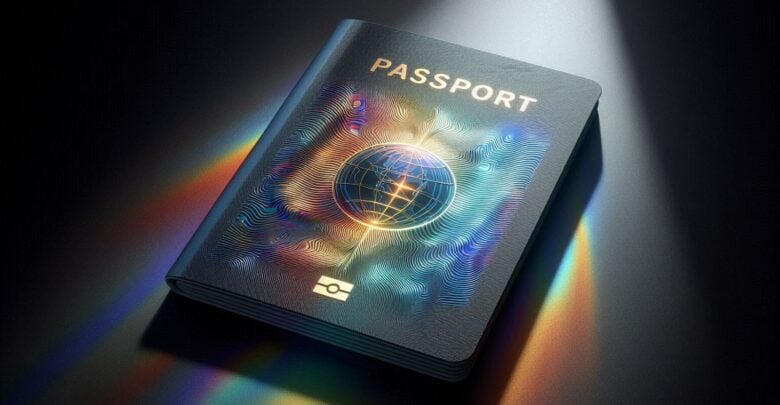
Passport Security Features Explained: Watermarks, Intaglio Printing, and Microprinting
From raised ink to hidden text, passport security features help governments detect fake documents and verify authentic identity records.

WASHINGTON, DC
A passport is supposed to do something very difficult. It must prove, often in seconds, that the person holding it is who they claim to be and that the document itself has not been altered, copied, or fraudulently issued. That challenge has shaped decades of security design. The result is the modern passport, a document that looks simple to the public but is built like a layered anti-counterfeit system.
Most travelers notice only the obvious parts: the cover, the photo, the name, and the page for stamps. Border officers and document examiners see something else. They see a surface filled with clues. They check how light passes through the paper. They tilt the page. They feel the ink. They inspect tiny lines of text that are almost invisible to the naked eye. They compare the printed information with what machines read and what biometric systems detect.
That is why passport security still depends so heavily on physical features even in an age of chips, databases, and facial recognition. The digital tools matter more every year, but the booklet still has to prove itself physically the moment it lands on a counter.
Why the paper itself is part of the defense.
Passport security begins before any personal details are printed. The material of the document matters because counterfeiters are usually strongest at surface imitation, not deep construction. A fake may copy a layout or a color palette, but it is much harder to reproduce the internal features built into the substrate itself.
Watermarks remain one of the oldest and most effective examples. They are not simply printed on top of the page. They are embedded during manufacture, which means they become part of the paper or material structure. When held to light, a genuine watermark behaves in a specific way. A copy may mimic the appearance in a flat image, but it often fails under real inspection because the feature is not built into the document at the same depth or quality.
This is one reason governments still rely on watermarks. They are quiet, elegant, and difficult to fake well. They do not need batteries, readers, or software. They just need light and an examiner who knows what to look for.
As the U.S. State Department notes in its description of the Next Generation Passport, current U.S. passport books combine upgraded physical construction with anti-tamper measures such as a polycarbonate data page, laser engraving, and embedded security features designed to make manipulation far harder.
Intaglio printing gives the page a feel that copies struggle to match.
Intaglio printing is one of the most underrated security features in travel documents because it works through touch as much as sight. In intaglio, ink is pressed into engraved lines under high pressure, creating raised printing that can often be felt by hand. To the average traveler, it may just seem like crisp, premium printing. To an examiner, it is a tactile security test.
That raised feel matters because many counterfeit methods flatten the page. Standard digital printing can imitate color and shape, but it usually cannot reproduce the same depth, texture, and edge clarity as true intaglio work. A document might look convincing from a short distance yet fail immediately when touched or viewed under magnification.
Intaglio also helps because it produces sharp detail. Fine line portraits, emblems, borders and lettering can be printed with a distinctive precision that is difficult to simulate with ordinary commercial equipment. This makes the feature useful both for fast handling and for more detailed forensic inspection.
In practical terms, intaglio printing turns a passport page into something more than a flat graphic. It becomes a textured object. That gives border officers another way to check authenticity without relying only on visual appearance.
Microprinting is small by design, but powerful in practice.
One of the smartest passport security features is also one of the hardest for travelers to notice. Microprinting uses extremely small text, often woven into lines, borders, or design elements, that appears clean under magnification but tends to blur, break, or smudge when copied.
That is what makes it valuable. Counterfeiters often work by scanning, reprinting, or reconstructing visual elements. Microprinting punishes that method because the tiny characters degrade easily when reproduced without the original printing precision. What should read as crisp hidden text may become a broken line, a muddy blur, or an unreadable smudge.
This is why microprinting is so often placed where it seems decorative. It may form part of a border, a signature line, a patterned box, or a background design. To the public, it looks like a normal element. To a trained examiner, it is a built-in challenge. If the hidden text is sharp and correct, confidence rises. If it collapses under inspection, suspicion follows.
The same logic appears across the wider document security industry. In its discussion of the modern components that make passports secure, Amicus International Consulting highlights how physical features such as microprinting, holograms, UV elements, and machine-readable zones work best when they overlap, forcing the document to authenticate itself in more than one way.
The smartest security features work in layers.
No single feature makes a passport secure. Watermarks alone are not enough. Intaglio alone is not enough. Microprinting alone is not enough. The strength comes from combination.
A genuine passport is built so one feature supports another. The paper behaves correctly under light. The raised printing feels right in the hand. The microtext stays sharp under magnification. The laminate reacts as expected. The serial elements are placed where they should be. The machine-readable zone scans properly. The chip, if present, aligns with the printed identity. The person holding the document matches the face and data embedded in it.
This layered structure is what frustrates counterfeiters. They may reproduce one element fairly well, sometimes even two. But matching the full performance of a real document across touch, sight, magnification, scanning, and identity verification is much harder.
That is also why modern border control is increasingly designed around overlap rather than trust in a single checkpoint. One feature may raise doubt. Several together can confirm fraud.
Why physical features still matter in the digital era.
It is tempting to think that chips and biometrics have made older physical security techniques less important. In reality, the opposite has happened. Physical features now play a larger role in the first moments of inspection, when an officer must decide whether the document deserves trust before moving deeper into the process.
A passport still has to look and feel right before it ever reaches the full digital verification stage. Watermarks, intaglio printing, and microprinting help establish that first credibility. They are fast, low-tech tests with high security value.
The broader enforcement trend supports that approach. A recent Reuters report on the European Union’s rollout of its digital Entry/Exit System noted that the project is designed to electronically register traveler data, link travel documents to biometrics, and help combat identity fraud. That system represents the future direction of border control, but even there, the document itself still matters. A digital border starts with a physical passport that must survive the first layer of scrutiny.
Why counterfeiters often target the process instead of the page.
As passport design has improved, many fraud schemes have shifted away from direct forgery and toward weaker points around the issuance system. Instead of flawlessly recreating a passport, criminals may try to exploit stolen breeder documents, fake applications, corrupt insiders or identity mismatches.
That shift says a great deal about the strength of modern passport security. It is often easier to manipulate the path to a document than to perfectly imitate the finished product. Governments understand this, which is why passport security now includes not just print technology but photo rules, enrollment controls, database checks, and increasingly biometric comparison.
Even so, the physical booklet remains central. When fraud is suspected, the physical features are often the first evidence that something is wrong. A missing tactile effect, a weak watermark, soft microtext, or inconsistent printing can be enough to move a traveler into deeper inspection.
Why raised ink and hidden text still beat cheap copying.
For all the sophistication of modern fraud, many counterfeit attempts still rely on the same basic weakness, the assumption that if a document looks close enough, it will pass. Passport security features are designed to destroy that assumption.
Raised intaglio exposes flat copies. Microprinting exposes low-resolution reproduction. Watermarks expose surface imitation. Together, they force the fraudster to do more than recreate the general look of the page. They must reproduce the engineering logic of the document itself.
That is why these features continue to matter in 2026. They are not old-fashioned leftovers from a pre-digital age; they remain some of the most practical and reliable ways to distinguish real travel documents from fake ones. They are quick to inspect, hard to imitate, and effective across borders.
A passport is not secure because it looks official. It is secure because it keeps proving itself under different kinds of pressure. Hold it to the light, tilt it, touch it, magnify it, scan it, compare it to the traveler. A genuine document is built to survive all of that. A fake usually begins to fail long before the inspection is over.