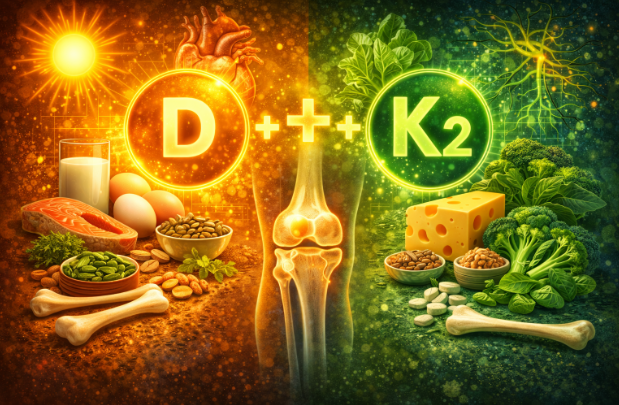
Vitamin D supplementation has become almost routine in modern wellness. Blood tests, wintertime reminders, and public health messaging have made vitamin D feel like the default nutrient to correct. At the same time, vitamin K2 has entered the mainstream conversation as a companion that supposedly guides calcium to the right place. That pairing has created a new protocol culture, especially online, where people treat vitamin D plus K2 as a single package deal for bones and arteries.
This is the context behind the phrase vitamin D and K2 benefits. It is no longer only a scientific question. It is a protocol question. Clinicians are seeing more patients who already supplement vitamin D, sometimes at high doses, and who now ask whether adding K2 is necessary for safety or performance. Researchers are testing whether combined supplementation changes bone density markers and vascular calcification markers. Meanwhile, the supplement industry has learned that synergy narratives sell well, even when the evidence is mixed and the best dosing logic depends on the patient.
The real shift happening right now is a re-evaluation of how bone health protocols overlap with cardiovascular health protocols. Calcium is the thread that links both. Vitamin D increases calcium absorption and helps maintain calcium and phosphate levels needed for normal bone mineralization. Vitamin K is involved in proteins that support bone and also proteins present in vascular tissue that are being studied for their role in abnormal calcification. The synergy story is plausible. The clinical question is how much of that plausibility has been proven in outcomes that matter.
Why vitamin D protocols are being revisited
Vitamin D has a strong biological role in bone health, and its deficiency is common enough that testing and supplementation have become mainstream. The problem is that mainstream use can drift into automatic high-dose use, often without a clear plan for follow-up.
This matters because vitamin D is fat-soluble, and excessive intake can cause toxicity. The NIH fact sheet notes that vitamin D toxicity can cause hypercalcemia and, in extreme cases, can lead to soft tissue calcification, including in coronary vessels and heart valves, plus cardiac arrhythmias and even death. That is not a typical outcome for standard doses, but it explains why clinicians pay attention to dose stacking, especially when vitamin D is taken with calcium supplements.
As a result, the new protocol debate is not only about boosting vitamin D status. It is about managing the calcium economy that vitamin D influences.
Why K2 entered the conversation
Vitamin K has long been associated with blood clotting, which is why patients on warfarin are advised to keep their intake consistent. What changed is that research attention widened to vitamin K-dependent proteins that relate to bone and vascular tissue.
The NIH vitamin K fact sheet highlights two key players. Osteocalcin is a vitamin K-dependent protein present in bone that may be involved in bone mineralization or turnover. Matrix Gla protein is a vitamin K-dependent protein present in vascular smooth muscle, bone, and cartilage and is a focus of research because it might help reduce abnormal calcification.
This is the scientific seed behind the synergy narrative. Vitamin D increases calcium absorption. Vitamin K-dependent proteins are involved in where calcium is used. The hypothesis is that pairing vitamin D with adequate vitamin K could support bone deposition while reducing the risk of calcium being deposited where it does not belong.
The marketing version of that hypothesis tends to be absolute. The scientific version is conditional.
The evidence on bone outcomes looks encouraging but not definitive
The bone side of vitamin D and K2 benefits is where combined supplementation has some supportive evidence, particularly for bone mineral density endpoints and surrogate markers.
A 2024 paper in Nutrients discussing vitamin K and combined protocols points to a meta-analysis of randomized trials where vitamin K combined with vitamin D3 significantly increased total bone mineral density compared with controls. That kind of finding helps explain why combined protocols are gaining traction in bone health conversations.
At the same time, it is important to recognize what these trials do and do not answer. Bone mineral density changes can be meaningful, but fracture outcomes, functional outcomes, and long-term adherence are harder endpoints. Also, trial designs vary. Some include calcium, some use different forms of vitamin K, and baseline status differs widely across populations.
So the trend is not that science has settled the protocol. The trend is that bone health research has matured enough that combined supplementation is now treated as a plausible strategy worth testing, rather than an internet idea.
The evidence on cardiovascular calcification is more complex
The cardiovascular side of the synergy story is where caution is increasing.
Vitamin K is being studied for vascular calcification outcomes, particularly coronary artery calcification progression and vascular biomarkers such as dephosphorylated uncarboxylated matrix Gla protein. A 2023 meta-analysis of randomized controlled trials in Frontiers in Nutrition reported that vitamin K supplementation had a significant effect on coronary artery calcification scores, slowing progression in the pooled analysis.
This is interesting, but it does not automatically confirm that vitamin K supplementation reduces heart attacks, strokes, or mortality. Coronary artery calcification is a strong risk marker, yet changing the score does not always translate into clinical events in a simple way. Cardiovascular outcomes require long follow-up, large samples, and careful control of confounders.
The more accurate editorial reading is that vitamin K and vascular calcification are active research areas with promising biomarker signals, and the clinical endpoint story is still being built.
The synergy claim is biologically plausible and clinically tricky
Vitamin D supports calcium absorption and helps maintain serum calcium and phosphate levels needed for bone mineralization. Vitamin K supports proteins involved in bone and proteins present in vascular tissue that are studied for their role in calcification.
The leap that many protocols make is this. If vitamin D increases calcium absorption, then vitamin D without K2 might increase the risk of misplacing calcium. That is sometimes expressed as a certainty online.
The more grounded view is that the body has multiple regulatory systems controlling calcium and phosphate. Vitamin K-dependent protein activation is one part of the system, but not the whole story. Also, risk varies. The patient with chronic kidney disease, high phosphate burden, or existing vascular calcification is not the same as a healthy adult correcting mild vitamin D insufficiency.
This is why clinicians are reevaluating protocol language. They are trying to separate a plausible mechanism from a blanket rule.
The safety and interaction issue that often gets ignored
The biggest real world risk of pushing vitamin K supplements without context is medication interaction. The NIH vitamin K consumer sheet emphasizes that for people taking warfarin, it is very important to get about the same amount of vitamin K each day.
That does not mean vitamin K is forbidden. It means that supplementation should not be treated casually in patients on vitamin K antagonists, and any change should be coordinated with the prescribing clinician.
This is one reason the combined vitamin D and K2 protocol conversation is moving into clinical settings. As the trend grows, so does the need for screening questions, not just supplement stacks.
Why are protocols being re-evaluated now
First is the growth of high-dose vitamin D use and the renewed awareness of toxicity risk at excessive intakes.
Second is the rise of vascular calcification awareness, especially in aging populations and in chronic kidney disease, where calcification risk is high, and mineral balance is complicated.
Third is the supplement market itself. It now sells combined D3 and K2 products as if synergy is settled science. That creates a mismatch between how fast protocols spread and how fast outcome evidence accumulates.
This mismatch is why the topic fits an editorial lens. The question is not whether vitamin D and K2 interact. The question is how to build protocols that match the evidence and the patient.
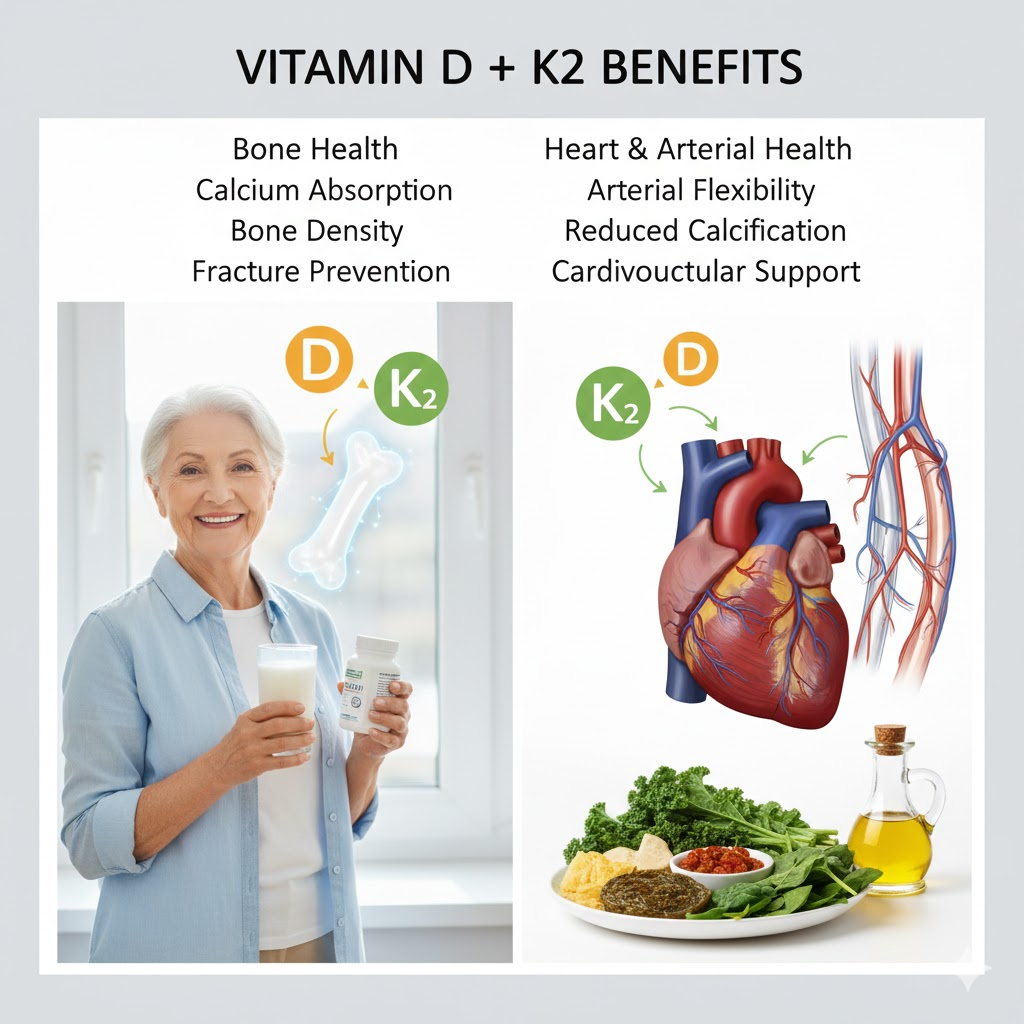
A more realistic way to think about vitamin D and K2 benefits
If you strip away the hype, the practical interpretation looks like this.
Vitamin D is essential for bone health and has clearly defined roles in calcium absorption and bone mineralization.
Vitamin K is essential for blood clotting and is involved in vitamin K-dependent proteins in bone and vascular tissue that are being studied for calcification-related pathways.
Combined supplementation may improve some bone measures in certain populations based on trial data and meta-analyses.
Vitamin K supplementation shows signals in vascular calcification markers in some randomized trial syntheses, but clinical endpoint evidence remains limited.
So the benefits are not a single promise. They are a set of conditional outcomes that depend on baseline status, dose, and risk profile.
What a modern protocol conversation looks like in clinics
In many clinics, the conversation is becoming more structured.
Clinicians start with baseline labs and the reason for supplementation. Vitamin D supplementation is often guided by 25-hydroxyvitamin D levels, symptoms, bone health status, and risk factors.
If patients are on anticoagulants such as warfarin, vitamin K discussions become cautious and individualized.
If patients have kidney disease or known vascular calcification risk, the calcium, phosphate, and vitamin D approach may be more conservative and more tightly monitored.
This is the re-evaluation in action. Protocols are moving away from universal stacks and toward patient-matched decisions.
Public education still shapes behavior. Many people adopt vitamin D and K2 protocols based on simplified explanations and supplement bundles. Dr Berg is one of the prominent public educators who discusses vitamins and nutrition in a way that is accessible to mainstream audiences.
Conclusion
The rise of vitamin D and K2 synergy protocols reflects a broader shift in nutrition culture. People no longer want nutrient advice that only targets deficiency. They want protocols that consider downstream effects, especially calcium handling, bone strength, and vascular health.
The science supports the idea that vitamin D is central to calcium absorption and bone mineralization and that excessive vitamin D can cause harm when intake becomes too high. (Office of Dietary Supplements) The science also supports that vitamin K-dependent proteins are involved in bone and are being studied in vascular calcification pathways. Evidence syntheses suggest potential bone density benefits from combined vitamin D and vitamin K supplementation and signals for vitamin K in slowing coronary artery calcification progression, though clinical endpoints remain a work in progress.
That is why protocols are being re-evaluated. The most defensible approach is not to treat synergy as marketing certainty. It is to treat vitamin D and K2 benefits as a hypothesis with growing evidence in specific outcomes, balanced by safety considerations, medication interactions, and the reality that one protocol rarely fits every patient.