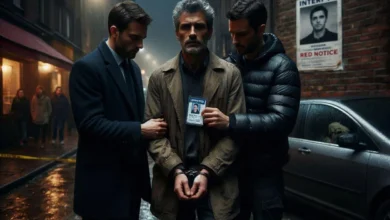
How Police Exposed the Suicide Note as a Fugitive Ruse
The missing person inquiry shifted into an international manhunt after investigators concluded Clacher had staged his own death.


WASHINGTON, DC, James Clacher’s disappearance near Loch Long began with the urgency of a missing-person search, but police eventually determined that the abandoned car and suicide note were not signs of death, but the first stage of a calculated fugitive escape.
The suicide note created an emergency that police could not ignore.
Clacher, a former gym owner from Bellshill in North Lanarkshire, vanished in May 2022 while facing rape charges involving two women he had met through dating apps.
His Suzuki Swift was found near Loch Long in Argyll and Bute, where a note suggested that he had taken his own life and forced authorities to treat the situation as a possible suicide emergency.
The scene demanded an immediate search because police cannot assume a missing person is staging a disappearance when a vehicle, note and remote waterside location all point toward possible self-harm.
That urgency is what made the ruse effective at first, because it redirected police into rescue and recovery mode before investigators could confirm whether Clacher was dead, hiding nearby or already fleeing Scotland.
The case later became a textbook example of pseudocide, where a person under legal pressure uses a staged death narrative to delay prosecution, exhaust resources and create enough uncertainty to escape.
The first clue was the timing.
Police had to investigate the disappearance as a potential tragedy, but Clacher’s legal circumstances made the timing impossible to separate from the criminal case already moving against him.
He was facing serious rape charges, had professional and legal pressure building around him, and had a clear reason to want the court process interrupted before evidence could be tested before a jury.
A genuine suicide could not be ruled out at the beginning, but investigators also had to ask who benefited if the note was believed and the missing person was treated as dead.
The answer pointed directly back to Clacher, because a confirmed death would have ended the prosecution, while uncertainty would delay proceedings and create space for flight.
That motive did not prove the ruse by itself, but it gave police the critical lens they needed as the search around Loch Long failed to produce a body.
The missing-person search slowly became an evasion inquiry.
The initial response reportedly involved extensive searches across difficult terrain, including water, shoreline and surrounding areas, where a missing person might have drowned, hidden or become injured.
As days passed without proof of death, investigators began shifting from the assumption of immediate risk toward the possibility that the suicide note was a staged device.
That transition is crucial in fake-death cases because police must run two inquiries at once, one focused on finding a vulnerable missing person and another focused on tracing a suspect who may be using the search as cover.
The missing-person inquiry, therefore, widened into checks on movement, communications, money, travel routes, possible assistance and whether Clacher had prepared before vanishing.
According to Police Scotland, extensive inquiries after the missing-person report eventually showed that he had left the country to evade justice after faking his own death.
The absence of a body changed the meaning of the note.
A suicide note can feel conclusive in the first hours of a disappearance, but its meaning weakens when searches do not find remains, witnesses, physical evidence or a credible death mechanism.
At Loch Long, the note and abandoned vehicle suggested a possible ending, yet the missing body prevented investigators from closing the case as a confirmed suicide.
That uncertainty mattered because a staged death depends on emotional plausibility, while an investigation depends on evidence that survives testing across time, location and behavior.
Once police could not confirm death, the note began to look less like a farewell and more like an instrument designed to create delay.
The same document that initially triggered concern later became part of the evidence that Clacher had manipulated the emergency response to buy time for escape.
The false note also attempted to control the victim narrative.
Reports said the suicide note sought to blame one of the women who had accused Clacher, a detail that made the staged scene more damaging than a simple flight from prosecution.
That allegation mattered because the note did not merely suggest self-harm, it attempted to redirect guilt, sympathy and emotional pressure toward a victim while the legal case was still unresolved.
A false suicide note can become a tool of narrative control, recasting an accused person as destroyed by accusation and shifting public attention away from the conduct alleged against him.
In Clacher’s case, the note added another layer of manipulation because it tried to influence how others interpreted the rape charges before a court could hear the evidence.
The later convictions made that tactic even more disturbing because the women’s testimony and the jury verdicts outlasted the false story he left behind.
Police followed the practical trail left by a living fugitive.
A person who truly dies leaves a different trail from a person who is secretly moving, spending money, communicating, preparing travel and surviving under another identity.
Once investigators suspected Clacher was alive, the inquiry had to move beyond Loch Long and into the practical question of how he could have left, where he could go and what support or resources he might use.
That meant police had to examine whether he had withdrawn funds, arranged transport, used survival skills, contacted others or prepared documents before disappearing.
The ruse depended on making police look at the water, but the fugitive trail pointed toward movement away from the scene and eventually away from Scotland.
That investigative shift is how many staged-death plots collapse, because the living person must continue creating evidence after the false death scene is staged.
The inquiry eventually crossed borders.
Clacher’s case moved from a Scottish missing-person inquiry into an international fugitive investigation once police concluded that he had survived the Loch Long scene and left the country.
That shift brought in partner agencies, international warrants and cooperation with Spanish authorities, reflecting the seriousness of a rape suspect wanted after staging a death scene.
Police Scotland later said he was traced in Spain in May 2024 and returned to Scotland to face trial, completing the transformation from missing man to fugitive defendant.
The international dimension mattered because it showed that a staged suicide can delay local proceedings, but it does not erase warrants, charges or the cross-border tools available to police.
Clacher’s eventual arrest abroad proved that Loch Long was not the place where his story ended, but the place where the escape plan began.
Spain exposed the false life behind the suicide claim.
Clacher was found in Nerja on Spain’s Costa del Sol, where he had reportedly lived under the alias Johnny Wilson while integrating into local fitness, outdoor and expatriate circles.
That Spanish life contradicted the suicide narrative entirely because a man supposedly lost near Loch Long was alive, socially visible and living under a new identity in another country.
Sky News later reported on the false identity Clacher built in Spain, describing how the former gym owner used a new name while living openly in Nerja.
That discovery exposed the central weakness of the ruse, because a staged death may hide a suspect briefly, but the fugitive must still live, work, socialize and interact with people who can eventually identify him.
The false suicide note had tried to stop one story, but the Spanish alias created another trail that police and reporters could follow.
The public tip and police cooperation closed the circle.
Clacher’s arrest in Spain followed investigative persistence, public attention and cooperation between agencies that treated the case as active despite the earlier suicide claim.
The fugitive life ended when authorities identified him abroad and arrested him on a warrant, proving that the staged death had only delayed the criminal process.
The case showed how public reporting, police coordination and local observation can converge when a fugitive lives openly enough to become familiar in a community.
That is the paradox of false identity abroad, because a fugitive needs ordinary social contact to survive, but every interaction creates a possibility of exposure.
Once Clacher was detained, the Loch Long note was no longer a plausible final message, but an evidentiary marker in a failed attempt to evade trial.
The return to Scotland restored the rape case to court.
After being extradited, Clacher stood trial at the High Court in Glasgow and was convicted in September 2025 of raping two women in attacks committed in 2019 and 2020.
The sentencing court later imposed a 10-year extended sentence, including eight years in custody and two years on licence, after describing striking similarities between the offences.
The official Scottish sentencing remarks in HMA v. James Clacher noted that he used dating apps, lied materially about his age, arrived earlier than arranged and attacked women in their homes.
Those findings returned the case to the victims and the evidence, which had been overshadowed for years by the staged suicide, Spanish fugitive life and false identity.
The court outcome proved that the suicide note could postpone the trial, but it could not defeat the testimony and investigation that eventually reached a jury.
The ruse harmed the victims before justice resumed.
For the women who accused Clacher, the staged death created an additional ordeal because the criminal case appeared threatened by his disappearance before their evidence could be fully heard.
A fake suicide can make victims believe the offender will never stand trial, while also forcing them to watch public attention shift from their allegations to the accused person’s supposed crisis.
The sentencing judge later recognized that Clacher’s self-imposed exile worsened the victims’ suffering, because his disappearance created delay, uncertainty and renewed trauma when the case returned.
That harm matters because fugitive behavior is not merely an offense against the court, but an extension of harm against those waiting for accountability.
The police investigation did not only expose a ruse; it restored the possibility that the women’s cases would be judged in court rather than buried beneath a false death story.
The false death also wasted emergency resources.
The Loch Long search required police, specialist units and emergency resources to respond as if a life might be at immediate risk, because the note and abandoned car could not be dismissed casually.
That resource diversion is one reason fake-death schemes are treated seriously, because they consume operational capacity while other genuine emergencies may also need attention.
The search was necessary because police had to protect life first, but the later discovery that Clacher had fled exposed the manipulation behind the scene.
A staged suicide forces authorities into a moral trap, because ignoring it risks missing a real death, while believing it can give a fugitive the exact head start he wants.
The Clacher case shows why investigators must search with urgency while also testing whether the scene was staged for legal advantage.
The false identity abroad was not lawful reinvention.
There are lawful reasons why people seek privacy, relocation or protected identity, including domestic violence, stalking, political persecution, witness protection and severe personal safety threats.
Clacher’s conduct belonged to a different category because the suicide note, flight and Spanish alias were used to avoid trial for serious sexual offences.
Professional discussions of new legal identity planning emphasize lawful purpose, verified documentation and government recognition, while Clacher’s alias was built around evasion.
That distinction matters because a new name can be lawful when it preserves accountability, but becomes criminal concealment when used to defeat courts, police and victims’ rights.
Clacher’s Spanish identity was not protection because it was the continuation of a ruse that began with a false suicide note beside Loch Long.
The case shows how staged deaths become investigative puzzles.
A staged suicide requires investigators to test several possibilities at once, including genuine self-harm, accidental death, hiding nearby, assisted flight and international escape.
Police must look for physical evidence at the scene, but also for contradictions in travel, money, communications, prior conduct, and legal motive.
In Clacher’s case, the inquiry moved through those stages until the missing-person theory gave way to the conclusion that the suspect had left Scotland.
That progression shows why fake-death investigations are rarely solved by one clue, because they require investigators to follow the absence of proof as carefully as the presence of suspicious evidence.
The suicide note may have been the opening clue, but the broader trail of movement and later discovery in Spain revealed its true purpose.
The professional misconduct record reinforced the pattern of avoidance.
Before the Loch Long disappearance, Clacher had already failed to disclose criminal charges to the regulator responsible for his dietitian registration, leading to professional misconduct findings and removal from the register.
That earlier nondisclosure showed that concealment was already part of his response to accountability before the fake suicide expanded the deception dramatically.
The professional record, the missing court appearance, the staged death, and the Spanish alias all formed a sequence of avoiding institutions that had authority over him.
That sequence helped explain why police eventually treated the note as part of a broader pattern rather than a standalone expression of crisis.
The ruse was not the first sign of evasion, but the most dramatic one.
Lawful anonymity and fugitive concealment remain opposites.
Legitimate anonymous living depends on compliant structures, valid records, and recognition by the systems that control identity, residence, banking, and travel.
Clacher’s disappearance depended on false death staging, non-engagement with police, breach of legal obligations, and an alias in Spain while rape charges remained pending.
That difference is essential because privacy can be lawful and necessary, while fugitive concealment corrupts emergency response, delays justice, and harms victims.
A lawful privacy structure can be verified, when necessary, but a fake suicide is designed to prevent verification by making the person appear dead.
The case makes the distinction clear because the suicide note did not protect Clacher from danger; it protected him temporarily from accountability.
The bottom line is that police exposed the note by proving Clacher was alive.
James Clacher’s suicide note near Loch Long initially forced police into a missing-person search, but the investigation shifted when no death was confirmed, and evidence pointed toward deliberate flight.
Police followed the contradictions from the abandoned car to the wider trail of movement, eventually treating the case as an international fugitive investigation rather than a local suicide inquiry.
His arrest in Spain proved that the note had been a ruse, not a farewell, and his extradition returned the rape charges to the court he had tried to avoid.
The later convictions and 10-year extended sentence confirmed that the staged death delayed accountability, but did not defeat it.
For the public record, the Clacher case stands as a warning that a suicide note can mislead police for a time, but evidence, persistence and cross-border cooperation can still bring the living fugitive back to justice.