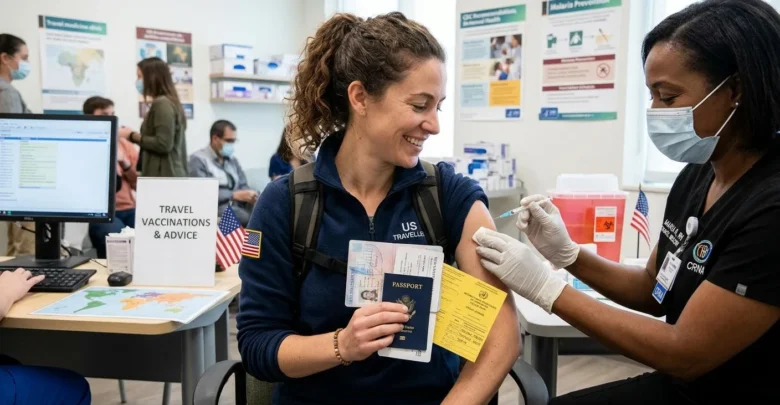
Health entry requirements may consider previous destinations and transit stops, not just passport nationality.
WASHINGTON, DC, October 25, 2026 — American citizens traveling internationally may face vaccination documentation requirements based not only on their nationality and final destination but also on countries visited earlier in their journey, airport transit arrangements, and time spent in regions associated with particular infectious diseases.
This distinction matters especially for United States passport holders traveling through Africa, South America, Southeast Asia, and other regions where public health authorities may require vaccination evidence from individuals arriving after visiting countries with recognized disease transmission risks.
Singapore’s health regulations, along with international guidance on yellow fever vaccination, show how travel history can affect admission requirements even when a traveler holds a passport from a country that ordinarily enjoys visa-free entry privileges.
An American traveling directly from the United States may therefore face different vaccination documentation requirements from another American arriving at the same destination after visiting a country associated with yellow fever transmission.
For international travelers, understanding how passport nationality, previous destinations, transit duration, and vaccination records relate is essential because a valid passport and appropriate visa do not automatically meet every public health condition governing entry.
Vaccination Requirements Can Depend on Where Travelers Have Been
International vaccination requirements often reflect a government’s assessment of infectious disease exposure associated with a traveler’s recent geographic history, rather than relying exclusively on the nationality recorded inside the passport.
This approach lets authorities distinguish between individuals arriving from countries without recognized transmission risks and travelers whose recent journeys included destinations where certain diseases remain a public health concern.
An American departing directly from a low-risk country may not need to present a specific vaccination certificate, while another citizen following a different itinerary may be subject to documentation requirements imposed by the same destination.
These differences can arise even when both travelers possess identical United States passports, travel for the same purpose, and intend to remain abroad for approximately the same period.
Consequently, immigration preparation should include reviewing the full travel route, not just the entry requirements for the final destination and the traveler’s citizenship.
Yellow Fever Provides a Clear International Example
Yellow fever is a mosquito-borne viral disease with transmission risks in parts of Africa and South America, so vaccination documentation is an important part of certain international public health entry procedures.
Under the International Health Regulations, countries may require travelers to present a recognized International Certificate of Vaccination or Prophylaxis when arriving from destinations associated with yellow fever transmission.
The U.S. Centers for Disease Control and Prevention’s Yellow Book guidance on yellow fever explains that entry requirements can apply to travelers arriving from designated countries, including circumstances involving airport transit.
Importantly, medical recommendations on whether an individual should be vaccinated do not always match legal requirements on whether a destination demands proof of vaccination at the border.
This distinction means travelers should evaluate both their actual health risks and the documentary conditions governments impose along their planned international route.
Singapore Examines Recent Travel History
Singapore provides a particularly useful example because its yellow fever entry requirements consider whether travelers visited countries associated with transmission risks in the six days before arrival.
According to the Singapore Immigration and Checkpoints Authority’s official yellow fever certificate guidance, travelers with relevant recent travel history must present valid vaccination documentation, including qualifying visitors holding United States passports.
The requirement aims to reduce the risk of yellow fever importation into Singapore, where authorities maintain public health safeguards even though the country is not classified as a yellow fever transmission destination.
The rules apply whether the traveler is a foreign visitor or a Singapore resident, showing that citizenship and immigration status do not necessarily determine the required health documentation.
For American citizens, the practical consequence is that an itinerary involving another country shortly before arrival in Singapore may create a vaccination certificate requirement that would not arise during direct travel from the United States.
Airport Transit Can Affect Vaccination Requirements
International airport connections can affect health entry rules because some governments consider qualifying transit periods through countries associated with yellow fever transmission when deciding whether vaccination evidence is required.
Singapore expressly includes airport transit lasting more than 12 hours in countries with recognized yellow fever transmission risks among the circumstances that trigger its vaccination certificate requirement.
This means an American traveler with an extended connection at an airport in a designated country may face additional documentation obligations upon arrival in Singapore, even without an ordinary tourist visit.
However, travelers should not assume the same 12-hour threshold applies universally, since other countries may define transit differently, exempt certain travelers, or set different requirements for international airport transfers.
The relevant assessment depends on the destination’s current public health regulations and the complete itinerary, including the specific countries and duration of previous connections.
Short Airport Connections May Be Treated Differently
Rules that set a time threshold may treat a brief international connection differently from a prolonged transit, showing why an airport stop’s duration can have legal significance.
Under Singapore’s published yellow fever requirements, the specific airport transit provision applies when travelers spend more than 12 hours in a country associated with yellow fever transmission.
However, a traveler who enters or visits such a country may fall under the broader recent travel history requirement, even if the airport connection itself would not have exceeded that threshold.
The distinction matters because an ordinary airside connection, an overnight stay outside the airport, and an extended visit can involve different circumstances under the receiving country’s rules.
Americans should therefore avoid interpreting transit exemptions as permission to disregard prior travel history, particularly where an itinerary requires immigration clearance or time outside the airport.
A Valid Certificate Has International Recognition
The International Certificate of Vaccination or Prophylaxis provides standardized evidence that a qualifying vaccination has been administered and properly documented, supporting recognition by authorities that assess international health entry conditions.
For yellow fever vaccination, the certificate generally becomes valid ten days after the initial vaccination and remains valid for the vaccinated individual’s lifetime under the applicable international framework.
This lifetime recognition reflects changes to international health rules that eliminated the former requirement for routine yellow fever booster certificates solely to maintain documentation validity.
However, a certificate must still be properly completed and issued under recognized procedures, so an ordinary vaccination receipt does not necessarily replace the required international documentation.
Travelers should confirm their records include the required identifying information and vaccination details before departing for destinations that may review the certificate.
Vaccination Timing Matters Before Departure
A traveler who receives an initial yellow fever vaccination shortly before international departure may have proof the vaccine was administered but not yet have a certificate valid for entry.
The ten-day period before the initial certificate becomes valid matters because travelers may not meet a destination’s entry requirements if they get vaccinated immediately before boarding.
Americans planning journeys through several countries should therefore review the timing of their entire itinerary, especially when a vaccination requirement may apply only after visiting another destination.
Medical advice should also account for individual circumstances, as certain travelers may have contraindications or precautions that affect the suitability of yellow fever vaccination.
Appropriate preparation involves consulting a qualified healthcare professional and reviewing official entry requirements early enough to address both medical suitability and certificate validity.
Medical Exemptions Require Separate Consideration
Some individuals cannot safely receive certain vaccines because of recognized medical contraindications, which may require international travel requirements to include medical waiver documentation rather than standard vaccination records.
The international yellow fever certificate framework allows medical exemptions, although destination countries retain the authority to determine how they evaluate such documentation under their public health regulations.
A medical waiver does not automatically guarantee admission without additional conditions, since receiving governments may impose precautions, quarantine requirements, or other measures according to their applicable laws.
Singapore’s requirements illustrate this distinction because travelers without valid certificates, including certain individuals unable to receive vaccination, may still face quarantine under the country’s infectious disease legislation.
Americans with relevant medical concerns should therefore obtain professional guidance before making travel arrangements, rather than assuming that inability to receive a vaccine automatically removes every destination-specific requirement.
Quarantine Can Be a Consequence of Missing Documentation
International public health procedures may provide for quarantine or other restrictions when travelers arrive without required vaccination evidence after visiting countries associated with particular infectious disease risks.
Singapore’s yellow fever rules allow quarantine for six days after departure from a country with recognized yellow fever transmission risk if an arriving traveler lacks a valid vaccination certificate.
The requirement can affect unvaccinated individuals, travelers whose certificates have not yet become valid, and certain individuals who cannot receive vaccination for medical reasons.
Foreign visitors who refuse a legally required quarantine may be denied entry, showing that failing to meet public health requirements can have consequences beyond ordinary visa eligibility.
These conditions reinforce the importance of confirming vaccination documentation before travel, rather than expecting to resolve missing certificates immediately upon arrival.
Previous Destinations May Matter More Than Departure Airports
An international itinerary may begin in the United States but include several countries before the traveler reaches the final destination, so the original departure point may not determine applicable vaccination requirements.
For example, an American traveling from New York to a country associated with yellow fever transmission before continuing to Singapore may face requirements linked to that intermediate destination.
By contrast, another American traveling directly from New York to Singapore may not face the same yellow fever certificate requirement because the individual’s recent geographic travel history differs.
The distinction matters because airline reservations and passport nationality alone do not establish whether a traveler has recently entered countries subject to specific health-related entry restrictions.
Travelers should therefore examine the destination’s relevant historical travel period and identify every country visited during that window, including qualifying airport connections.
Countries Can Define Geographic Risk Differently
Yellow fever transmission risk is not necessarily uniform across a country, and medical recommendations may identify specific geographic areas where vaccination is advised.
However, certain governments establish entry requirements based on travel to an entire listed country rather than distinguishing between individual cities, provinces, or regions within that destination.
Singapore’s rules illustrate this approach by treating travel to designated countries as a single category, even when localized medical risk assessments may differ.
This distinction prevents travelers from assuming that visiting only a large metropolitan area automatically removes a certificate requirement imposed on arrivals from the country as a whole.
Americans should therefore distinguish regional medical recommendations from the precise geographic definitions used in their next destination’s immigration and public health regulations.
Travel Changes Can Create New Vaccination Obligations
Flight cancellations, unexpected diversions, itinerary changes, and extra overnight connections may alter a traveler’s recent geographic history, potentially affecting the documentation required at later international borders.
An American initially planning a direct journey may face additional health-entry requirements if the revised route includes a country associated with yellow fever transmission.
However, the consequences depend on the actual route and the destination’s regulations, so it’s inappropriate to assume every unexpected airport stop automatically creates a vaccination requirement.
When airlines propose alternative connections, travelers should check whether the revised itinerary introduces new entry or transit conditions, especially when a specific duration threshold applies.
Travel insurance, airline rebooking arrangements, and standard immigration authorization cannot replace compulsory vaccination documentation when a destination’s public health rules expressly require it.
Airlines May Review Health Documents Before Boarding
Airlines can examine vaccination certificates and other required health documentation before international departure when destination rules make those records relevant to passenger acceptance.
These checks help transportation operators assess whether travelers appear to satisfy applicable entry conditions, although the receiving government’s immigration and health authorities retain responsibility for final admission decisions.
A valid United States passport and approved visa may therefore be insufficient for boarding when another required document concerns the passenger’s recent travel history or health-entry eligibility.
Conversely, possession of a valid vaccination certificate does not automatically establish immigration admissibility, since passport validity, visas, permitted activities, and other conditions remain separately applicable.
Travelers should therefore confirm documentary requirements with the destination’s competent authorities and ensure relevant vaccination records remain accessible during airline check-in and arrival examinations.
Electronic Passports Do Not Replace Vaccination Certificates
Modern electronic passports contain technologies intended to strengthen document authentication and verify the identity of legitimate holders, including digitally signed information and biometric identification features.
However, these systems do not ordinarily establish that travelers have received a particular vaccine or satisfy health documentation requirements arising from recent visits to countries associated with infectious disease risks.
Amicus International Consulting has examined the broader distinction between passport identification and supplementary travel documentation in Mexico’s Children’s Passports Include Parents’ Photos to Strengthen Travel Security, illustrating how official documents can address separate verification purposes.
Although that analysis concerns parental identification rather than international vaccination requirements, the underlying principle remains relevant because a passport’s authenticity does not establish compliance with every condition governing international entry.
Public health certificates, immigration authorizations, and secure identification documents therefore perform complementary functions rather than serving as interchangeable evidence of travel eligibility.
Traveling With Children Adds Further Considerations
Children may be subject to age-specific vaccination requirements or exemptions, so families should review how the destination applies public health rules to minors traveling internationally.
Singapore’s yellow fever requirements recognize specific circumstances involving young children, but eligibility for an age-related vaccination exemption does not necessarily waive all quarantine or public health measures.
Parents should therefore distinguish medical suitability, vaccination age restrictions, and legal entry documentation requirements rather than assuming that children automatically qualify for the same treatment as adult travelers.
Families should also ensure that any required international vaccination certificate accurately identifies each child, since a parent’s documentation does not replace the child’s personal health record.
These considerations matter most when household members take different routes or when the family itinerary includes long connections in countries with additional public health requirements.
Health Recommendations Are Not Always Legal Entry Requirements
Public health agencies recommend various vaccinations and preventive measures to reduce travel-related disease risks, but these medical recommendations should not automatically be described as compulsory immigration conditions.
The CDC distinguishes between vaccinations recommended to protect individual travelers and documentation that governments legally require before admitting certain visitors.
A country may recommend protection against a particular disease without requiring proof of vaccination at the border, while another destination may impose a certificate requirement based on previous travel through designated regions.
This difference matters because travelers should obtain appropriate medical advice without assuming that every recommended vaccine must be documented as a condition of entry.
Accurate international travel preparation requires considering both personal health protection and the separate legal requirements set by the involved governments.
Official Requirements Can Change During Travel Planning
International vaccination entry requirements can change in response to developments in disease transmission, amendments to public health legislation, and revised government assessments concerning travelers arriving from particular countries.
A destination that previously imposed no vaccination certificate requirement on a specific route may later introduce conditions for travelers with certain recent travel histories.
Conversely, governments may remove or revise requirements as public health circumstances or regulatory frameworks change, making historical information potentially unreliable.
American travelers should therefore consult current official guidance from the destination’s immigration and health authorities rather than relying exclusively on older travel websites or previous personal experiences.
Reconsider the full itinerary whenever significant routing changes occur, especially when vaccination requirements depend on recently visited countries or qualifying airport connections.
International Travelers Need Route-Specific Health Preparation
Effective preparation starts with identifying the full itinerary, including departure points, intermediate destinations, airport transit times, overnight connections, and the countries entered before the final destination.
Travelers should then determine whether the receiving government requires a vaccination certificate based on nationality, recent travel history, transit duration, or another legally defined condition.
When vaccination is required or medically recommended, consult a qualified healthcare professional to determine the right timing, documentation, and consideration of individual medical risks.
Americans should also verify whether electronic or physical vaccination records are accepted, particularly when a destination requires the prescribed International Certificate of Vaccination or Prophylaxis.
Careful preparation reduces the chance that an overlooked health documentation requirement from an earlier travel segment will undermine a technically valid passport and immigration authorization.
Conclusion: Travel History Can Determine Vaccination Documentation
Vaccination entry rules for United States citizens cannot always be determined from passport nationality or final destination alone, because some governments consider recent travel history and airport transit arrangements when establishing health documentation requirements.
Singapore’s yellow fever regulations show that visitors arriving after travel through designated countries may need a valid vaccination certificate, and qualifying airport connections over 12 hours can trigger additional obligations.
International health guidance further distinguishes vaccination recommendations from compulsory entry documentation, recognizing that medical protection and legal admission requirements may serve related but different purposes.
For American travelers planning complex international itineraries, understanding these distinctions can prevent unnecessary disruption while supporting compliance with legitimate measures intended to reduce the international spread of infectious diseases.
Ultimately, reliable travel preparation requires reviewing the entire journey, verifying current government requirements, and recognizing that even brief international connections can affect which health documents a United States passport holder must carry abroad.