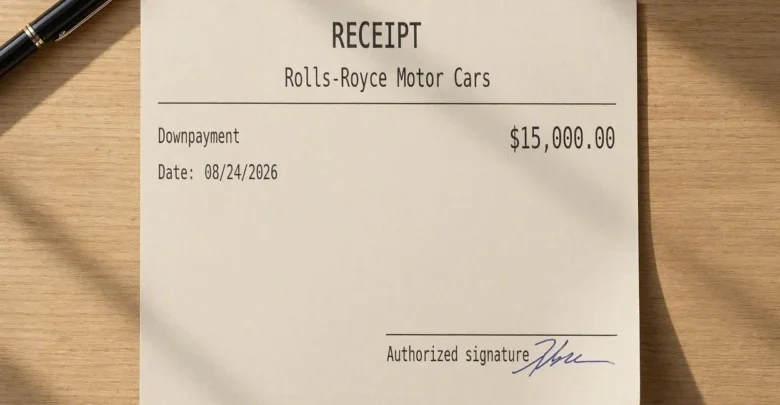
Prosecutors say a $15,000 wire from a hospice company account helped finance a lease-to-own arrangement for a Rolls-Royce Phantom, transforming one alleged financial transaction into a vivid centerpiece of the wider $27 million Medicare prosecution.
WASHINGTON, DC, August 23, 2026 — Federal prosecutors allege Los Angeles hospice operator Oren David Shachar transferred $15,000 from a company bank account as partial payment toward a lease-to-own down payment for a Rolls-Royce Phantom using money derived from health care fraud.
The luxury-car allegation appears in Count Thirteen of a 16-count federal indictment, where prosecutors describe a wire moving from Holly Trinity Hospice into another bank account while Shachar allegedly knew the transferred property represented proceeds from unlawful activity.
That relatively compact transaction carries outsized narrative importance because it gives jurors, taxpayers, and Medicare beneficiaries a tangible image of where prosecutors believe money generated through allegedly false hospice claims ultimately traveled after entering a provider-controlled account.
Shachar, Abraham Shin, and Jeannie Choi remain presumed innocent, and prosecutors must prove every claim involving the Phantom, hospice reimbursements, beneficiary information, kickbacks, and allegedly fabricated records beyond a reasonable doubt before imposing any criminal liability.
Count Thirteen traces a specific $15,000 wire
According to the federal indictment, the transfer occurred on or about September 20, 2024, when $15,000 moved from Holly Trinity Hospice’s JPMorgan Chase account ending in 8003 to a Wells Fargo account ending in 0248.
Prosecutors characterize the payment as one part of a down payment for a lease-to-own arrangement, meaning the charging document does not claim that this single wire purchased the Phantom outright or establish the automobile’s complete acquisition cost.
The government instead alleges that the $15,000 constituted criminally derived property worth more than $10,000 and that Shachar knowingly engaged in, or willfully caused others to engage in, a monetary transaction affecting interstate commerce.
By identifying the sending institution, receiving institution, approximate date, originating corporate account, transaction amount, and intended luxury purchase, Count Thirteen creates a narrowly defined financial event that investigators can test against bank records and related communications.
The indictment stops short of alleging the car’s full price
Some early news coverage of the Shachar case described the Rolls-Royce Phantom as worth approximately half a million dollars, although the indictment itself neither lists a vehicle price nor alleges that Medicare funds covered every payment under the arrangement.
That distinction matters because a criminal pleading should be reported according to what it actually charges, and the government’s allegation concerns a particular $15,000 transfer serving as a partial down payment, not a judicial finding about the entire vehicle’s financing.
The phrase lease-to-own also suggests an arrangement involving continuing payment obligations and a possible future ownership interest, yet the public indictment provides no schedule, contract duration, dealer identity, vehicle identification number, or final ownership status.
Prosecutors may possess additional documents through subpoenas, search warrants, bank returns, dealership records, or witness interviews, but those materials would ordinarily emerge through discovery and litigation rather than being inferred from the indictment’s limited public description.
Why one luxury payment can strengthen a financial narrative
Health care fraud cases can become dense collections of billing codes, certification forms, patient files, reimbursement rules, and electronic records, whereas a Rolls-Royce payment offers a memorable physical symbol that can make alleged proceeds trail easier for nonexperts to understand.
The government may use such evidence to argue motive, knowledge, benefit, or financial tracing, depending upon admissibility rulings and the evidence ultimately introduced, while defense counsel can challenge whether the transaction proves anything about the underlying hospice claims.
A luxury purchase can attract public attention far beyond its numerical importance, especially when the alleged Medicare payments reached approximately $26.908 million, but courtroom relevance depends upon authenticated evidence and legal elements rather than the automobile’s prestige alone.
The Phantom therefore should not eclipse the prosecution’s larger burden, because jurors would still need to evaluate whether claims were fraudulent, whether particular proceeds were traceable, and whether Shachar possessed the knowledge required for Count Thirteen.
Holly Trinity Hospice sits at the start of the alleged transfer
The sending account allegedly belonged to Holly Trinity Hospice, a Glendale-based outpatient hospice that prosecutors say Shachar owned, controlled, and operated beginning around April 2023, with an additional business location later identified in Valley Glen.
Corporate accounts commonly receive program reimbursements and pay legitimate operating expenses, so the government must connect this transfer to specified unlawful activity rather than relying merely upon the fact that money left a health care company’s account.
That tracing question may involve deposit timing, account balances, Medicare remittance data, other revenue, payroll, vendor payments, ownership authority, transfer instructions, and communications showing who requested the wire and why the recipient received it.
When legitimate and allegedly illicit funds coexist within one account, financial analysis can become especially contested, since prosecutors and defense experts may disagree about tracing methodologies, commingling, transaction purpose, and the inferences supported by account activity.
Separate proceeds charge changes the case’s structure
Count Thirteen invokes the federal prohibition addressing monetary transactions exceeding $10,000 in property derived from specified unlawful activity, with prosecutors naming health care fraud as the alleged unlawful source behind the Phantom-related transfer.
This accusation is distinct from proving that a hospice claim was false, because the government must establish a qualifying monetary transaction, criminal derivation, the required value threshold, and Shachar’s knowledge that the property represented proceeds from some unlawful activity.
The government does not necessarily need to show that a defendant knew every technical detail of the specific underlying offense, but it must satisfy the knowledge standard applicable to the charged proceeds transaction through admissible evidence.
Separating the luxury-car transfer into its own count gives prosecutors an additional theory of liability while allowing the defense to contest that transaction independently, even if jurors reach different conclusions about other fraud, kickback, or identity-theft allegations.
The alleged proceeds began with Medicare reimbursements
Prosecutors say four hospices connected to Shachar billed Medicare approximately $27.731 million between February 2021 and March 2026, while the federal program paid approximately $26.908 million for claims the government alleges were false, fraudulent, or otherwise nonpayable.
Those figures indicate that Medicare allegedly released about 97 percent of the amount submitted, creating a substantial pool of federal reimbursements that investigators could compare with company expenses, transfers, cash withdrawals, compensation, and personal or luxury spending.
The indictment says the claims included services that were medically unnecessary because beneficiaries were not terminally ill, services allegedly not provided because purported patients were already deceased, and enrollments obtained through illegal payments to recruiters or beneficiaries.
Prosecutors must nevertheless prove which claims were fraudulent and how challenged money moved, because a high reimbursement total does not automatically establish that every dollar entering a hospice account constituted criminal proceeds or funded personal consumption.
Four hospice companies allegedly supported the operation
The charged network includes Gentle Touch Hospice Care in Valley Glen, Oxford Hospice Care in Montclair, Art of Hospice in Encino, and Holly Trinity Hospice in Glendale, which prosecutors collectively identified as the Shachar Hospices.
Court filings describe ownership or operational relationships beginning at different times, potentially allowing investigators to reconstruct when each provider obtained Medicare access, enrolled beneficiaries, submitted claims, received reimbursements, and transferred funds among business or outside accounts.
Multiple entities can complicate oversight because billing volumes and patient patterns appear across separate provider numbers, yet common control, shared marketers, overlapping staff, connected accounts, and repeated documentation practices may reveal relationships during a coordinated investigation.
The Rolls-Royce allegation is especially significant within that structure because prosecutors identify one specific hospice account as the transfer’s origin, linking an operating company directly to spending they portray as a personal luxury benefit.
Beneficiary inducements allegedly sustained the billing stream
The indictment alleges Shachar paid some beneficiaries as much as $400 monthly to remain enrolled, while also providing groceries, alcohol, personal-care supplies, medical equipment, televisions, massages, furniture, and reclining chairs as additional inducements.
Prosecutors further claim beneficiaries could receive between $100 and $200 for referring another person, while patient marketers sometimes received about $700 for each living beneficiary each month Medicare continued receiving hospice bills.
Those recurring incentives allegedly rewarded extended enrollment and continuing reimbursement, which may help federal prosecutors explain how substantial company revenue accumulated before a portion was allegedly directed toward the Rolls-Royce lease-to-own down payment.
However, the existence, recipients, purpose, and legality of every alleged payment remain factual questions, and defendants may dispute witness credibility, characterize transfers differently, or challenge whether specific benefits were connected to federally reimbursable referrals.
Hospice eligibility makes the underlying allegations consequential
Medicare hospice coverage generally serves a beneficiary certified as terminally ill, ordinarily meaning that the person is expected to live six months or less if the illness follows its normal course, while care shifts toward comfort rather than cure.
Prosecutors allege Shachar concealed important conditions from prospective and enrolled beneficiaries, including the need for terminal-illness certification and the potential effect that hospice election could have upon Medicare coverage for curative services from other providers.
Improper hospice enrollment can therefore carry consequences beyond financial loss, because a beneficiary may misunderstand available treatment, experience disruption involving established physicians, or make consequential health decisions without receiving a complete explanation of the program.
Against that clinical backdrop, the Rolls-Royce transfer presents the contrast prosecutors are likely to emphasize: public money designated for vulnerable patients allegedly left a hospice-controlled account to support an exceptionally conspicuous luxury automobile arrangement.
Deceased identities allegedly helped conceal suspicious patterns
The indictment alleges Shachar purchased names, Social Security numbers, birth dates, Medicare identifiers, death information, physician details, and next-of-kin information belonging to deceased beneficiaries from marketers connected to a Los Angeles-area funeral home.
Prosecutors say nurses, a physician, office employees, and others then helped create or support backdated records portraying those individuals as evaluated, terminally ill, and enrolled before death, although the government contends the documentation was fabricated afterward.
The government claims these deceased enrollments reduced scrutiny of a high live-discharge rate and offset Medicare’s annual per-patient spending limit, giving the alleged identity misuse both a billing purpose and a concealment function.
Amicus International’s reporting on identity crimes and unlawfully constructed identities explains why stolen identifiers can become foundational tools for larger frauds when records, institutional access, and personally identifiable information are combined across systems.
The Rolls-Royce becomes the prosecution’s visual shorthand
Luxury automobiles regularly become prominent exhibits in financial prosecutions because they are recognizable, photographable, valuable, and easy to contrast with the taxpayers, patients, investors, or benefit programs portrayed as victims of an alleged scheme.
That symbolism can be powerful, yet courts still require evidentiary discipline because wealth, expensive taste, or vehicle possession is not inherently criminal, and prosecutors cannot replace proof of unlawful source, knowledge, and transaction purpose with moral disapproval.
Defense lawyers may seek to exclude prejudicial imagery, narrow testimony about the automobile, establish other funding sources, dispute who benefited from the arrangement, or argue that the transfer was a legitimate company-related transaction lacking criminal knowledge.
Prosecutors, conversely, may attempt to present account records, purchase documents, messages, testimony, and timing evidence as a coherent sequence connecting Medicare reimbursements, hospice control, transfer authorization, and the lease-to-own arrangement described in Count Thirteen.
Forfeiture could reach proceeds and substitute property
The indictment includes criminal forfeiture allegations seeking property constituting or derived from proceeds traceable to charged offenses, along with money judgments reflecting unavailable property and substitute assets when directly traceable property cannot be located or recovered.
Those provisions become relevant when property has been transferred, sold, deposited with another person, moved beyond the court’s jurisdiction, substantially reduced in value, or commingled so thoroughly that division becomes difficult after conviction.
The Rolls-Royce itself is not specifically identified in the public indictment’s forfeiture section as an item already seized, so readers should not assume that the government presently possesses the automobile or has established ownership through a final order.
Comparable prosecutions discussed in Amicus International’s analysis of luxury-asset seizures and federal forfeiture show why expensive cars, properties, and bank accounts can become parallel legal battlegrounds while defendants contest the underlying criminal allegations.
Lease financing can generate extensive documentary evidence
A lease-to-own arrangement may produce applications, credit reviews, identity documents, payment instructions, contracts, insurance records, title information, registration materials, delivery records, servicing history, and communications that can identify relevant participants and financial sources.
Banking institutions likewise preserve originator details, beneficiary information, timestamps, authorization methods, account statements, compliance alerts, and internal review notes, potentially giving investigators a durable documentary evidentiary trail that differs substantially from cash-based spending.
Dealership personnel, brokers, lessors, accountants, employees, or account signatories could become witnesses if they observed the arrangement, processed the wire, understood its stated purpose, or communicated with Shachar and hospice representatives around the transfer.
Whether those records support the indictment’s theory will depend on authentication, completeness, context, and cross-examination, because even apparently straightforward financial documents can raise disputed questions about authority, knowledge, ownership, and source of funds.
The defendants face overlapping but individualized allegations
Shachar is charged with conspiracy, substantive health care fraud, aggravated identity theft, the proceeds transaction, kickback violations, and selling Medicare beneficiary identifiers, while Shin and Choi face allegations tied principally to conspiracy, fraud, identity information, and referrals.
Prosecutors say Shin and Choi sold information involving living and deceased beneficiaries during 2025, but Count Thirteen names Shachar alone and concerns a September 2024 transaction that occurred before their charged participation in the broader scheme.
That chronology underscores why prosecutors must assess responsibility separately for each defendant and count, rather than treating association with one alleged conspiracy as automatic proof that every participant knew about every payment or financial decision.
Shachar and Shin were arrested and arraigned on June 18 before being released on bond, while Choi was arrested several days later, according to the Justice Department’s public announcement concerning the Southern California cases.
The case emerged from a nationwide enforcement operation
Federal authorities announced charges against 455 defendants, including 90 physicians and other licensed professionals, in cases alleging more than $6.5 billion in fraudulent claims across 56 federal districts and 45 states and territories.
The coordinated action involved more than $182 million in announced seizures of cash, luxury vehicles, jewelry, and other assets, placing Shachar’s alleged Rolls-Royce payment within a broader enforcement strategy focused on following proceeds beyond provider billing systems.
Government agencies also pursued payment suspensions, revoked billing privileges, exclusions, civil settlements, and other administrative measures intended to stop suspected losses before criminal prosecutions conclude, reflecting the many enforcement tools surrounding federally funded health programs.
Within the Central District of California, prosecutors announced ten defendants across cases involving hospice billing, prescription drugs, laboratory testing, psychiatric reports, controlled substances, and other alleged abuses of government-supported public health care programs.
Compliance teams can learn from the alleged money trail
Hospice operators should maintain clear separation between organizational spending and personal benefits, require documented business purposes for large transfers, limit account authority, reconcile reimbursements, and subject transactions involving owners or executives to independent review.
Boards and compliance officers should compare beneficiary eligibility, referral arrangements, claims, company accounts, vendor records, related-party payments, and high-value expenditures rather than auditing clinical files and financial ledgers as entirely unrelated compliance domains.
An unusual automobile payment does not prove fraud, but a transfer above reporting or statutory thresholds from a federally reimbursed provider to an unexplained outside account should receive documented review proportionate to its amount, recipient, and stated purpose.
Effective controls also require employees to report requests for backdating, concealed ownership, improper beneficiary benefits, questionable marketer compensation, or personal purchases routed through corporate accounts without fearing retaliation from managers controlling payroll or assignments.
Patients and taxpayers remain central to the alleged harm
The Rolls-Royce detail may dominate headlines, but the most serious allegations concern beneficiaries allegedly recruited into hospice without terminal illness, families whose deceased relatives’ information was allegedly exploited, and taxpayers who financed nearly every dollar submitted.
Legitimate hospice providers may also suffer reputational damage when alleged schemes create distrust around a service designed to provide pain control, counseling, nursing support, dignity, and comfort during profoundly difficult periods for patients and families.
Stronger death-data matching, ownership transparency, referral monitoring, payment analytics, and beneficiary outreach could help identify impossible timelines or abnormal incentives earlier, although every automated indicator still requires careful human review to avoid penalizing legitimate care.
The alleged $15,000 transfer illustrates why prevention must extend beyond claim approval, since money already disbursed can move rapidly through corporate accounts into assets or arrangements that become harder and more expensive for the government to unwind.
The Rolls-Royce allegation still awaits courtroom proof
When prosecutors announced the case, they said Shachar and Shin were scheduled for trial on August 11, although federal trial calendars frequently change through motions, continuances, discovery disputes, plea negotiations, and later judicial orders.
Future proceedings may address bank-record authentication, tracing methodologies, beneficiary eligibility, allegedly backdated clinical files, electronic communications, recruiter payments, corporate control, financial intent, forfeiture, and the admissibility of disputed evidence involving the Rolls-Royce arrangement.
The defense retains the right to test every witness, challenge every financial inference, offer lawful explanations for disputed transactions, and insist that the government prove each statutory element separately rather than relying upon the luxury vehicle’s emotional impact.
Until a verdict or other lawful resolution establishes the facts, the most accurate description remains carefully limited: prosecutors allege that $15,000 derived from health care fraud left a hospice account as a partial Rolls-Royce lease-to-own down payment.
That allegation gives the sprawling Oren Shachar Medicare case a striking symbol, but its ultimate legal significance will depend not upon the Phantom’s image or reputation, but upon reliable evidence tested openly under federal rules and constitutional safeguards.