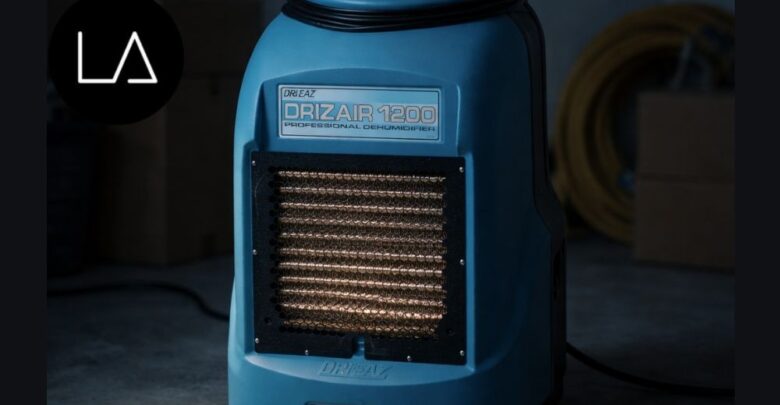
Running an industrial dehumidifier rental in Los Angeles overnight is standard practice in water damage recovery. After a flood or pipe burst, moisture doesn’t stop moving when the workday ends. Industrial-grade units are built for continuous operation, often rated for 24/7 duty cycles by manufacturers like Dri-Eaz. The real question isn’t whether you can run them overnight, it’s whether you’re running them correctly. Factors like room size, target relative humidity (RH), and unit placement all affect performance and safety. This guide covers what happens when dehumidifiers run through the night, what safety checks matter, and how LA Restoration Rentals can support your drying project in Los Angeles.
How Industrial Dehumidifiers Handle Continuous Operation
Industrial dehumidifiers differ from residential units in one key way: thermal load management. Residential units use basic compressor cycles that can overheat under sustained loads. Industrial LGR (Low Grain Refrigerant) dehumidifiers, like the Dri-Eaz LGR 7000XLi, use high-efficiency refrigerant loops designed to pull moisture at ambient temperatures as low as 33°F without shutting down.
Running these units overnight poses no mechanical risk when placed correctly. The IICRC S500 Standard for Professional Water Damage Restoration recommends continuous drying cycles to prevent secondary damage like mold colonization. Mold can begin developing within 24 to 48 hours of moisture exposure, according to the EPA’s mold remediation guidelines. Stopping the drying process at night resets moisture migration patterns and extends total project time.
Target Humidity Levels and Auto-Shutoff Settings
Most industrial dehumidifiers include a humidistat that monitors RH in real time. Contractors typically set a target RH between 30% and 50% for structural drying, per IICRC S500 protocols. Once the unit reaches that target, it cycles down automatically, reducing unnecessary runtime and energy draw.
Leaving a unit running overnight without setting a humidistat target wastes energy and can over-dry materials like hardwood flooring. Over-drying causes wood to crack and gap. The correct approach:
- Set the humidistat to the target RH before leaving the site.
- Check psychrometric readings each morning using a thermo-hygrometer.
- Log moisture content (MC) in structural materials daily using a pin-type meter.
- Adjust airflow from air movers to match dehumidifier grain depression output.
- Document RH and temperature readings at consistent intervals to track drying progress accurately.
Fire and Electrical Safety for Overnight Runs
Industrial dehumidifiers draw significant amperage. A standard 115V LGR unit pulls 7 to 12 amps continuously. Running multiple units on a single 15-amp circuit creates an overload risk. The U.S. Fire Administration reports that electrical overloads from restoration equipment are a known cause of structure fires during remediation projects.
Before leaving units running overnight, verify the following:
- Each unit is on a dedicated 15- or 20-amp circuit.
- Extension cords are rated for the unit’s full amperage draw.
- Water collection tanks or drain hoses are clear and unobstructed.
- No combustible materials are within 18 inches of the unit’s exhaust vent.
- The room has adequate air exchange to prevent heat buildup near the unit.
- GFCI outlets are used in any area where water contact is a risk.
Placement and Airflow for Overnight Drying
Unit placement determines how efficiently a dehumidifier dries a space overnight. Placing the unit in the center of the affected area maximizes air intake from multiple directions. Pairing it with air movers set in a vortex pattern forces moist air off wall cavities and subfloor assemblies directly into the dehumidifier’s intake.
A common error is placing the dehumidifier too close to an air mover outlet. This recirculates partially dried air rather than pulling fresh humid air from the structure. Dri-Eaz field training data shows that proper triangulated placement between air movers and dehumidifiers can reduce total drying time by up to 30% compared to random placement. For multi-room drying, each room with measurable elevated moisture content needs its own dedicated unit rather than relying on a single large unit in a hallway or central space.
Monitoring Moisture During Extended Overnight Cycles
Overnight drying requires a documentation protocol, not just equipment. Restoration contractors use psychrometric calculations to track the relationship between temperature, RH, and dew point. These three readings together determine whether drying conditions are progressing or stalling inside wall assemblies.
A drying log should capture readings at a minimum of two time points per day — once before the overnight cycle begins and once after. The goal is to show a consistent downward trend in moisture content (MC) across structural materials. IICRC S500 defines drying completion as structural materials returning to pre-loss equilibrium moisture content (EMC), which in Los Angeles typically ranges from 8% to 12% MC for wood-framed structures given the region’s average outdoor humidity levels.
When Overnight Operation Is Not Recommended
There are specific conditions where running a dehumidifier overnight requires added precaution. Spaces with standing water that hasn’t been fully extracted will overwhelm the unit’s capacity and may cause the collection tank to overflow if a continuous drain hose isn’t connected and cleared.
Category 3 water damage — sewage or grossly contaminated water — requires full containment before equipment runs unattended. Running equipment overnight in an unsealed Category 3 environment can spread aerosolized contaminants through the structure. The IICRC defines Category 3 water as water that poses substantial health risk. Remediation in these conditions requires controlled negative air pressure and HEPA filtration running alongside drying equipment before any overnight cycle begins.
Renting the Right Unit for Overnight Jobs in Los Angeles
Not every rental unit is rated for continuous overnight use. When sourcing an industrial dehumidifier rental in Los Angeles, confirm the unit carries an LGR rating, has a working humidistat with a digital display, and includes a continuous drain port. Units without a drain port require manual tank emptying, which makes overnight operation impractical in high-moisture environments.
LA Restoration Rentals provides LGR-rated industrial units with continuous drain capability across Los Angeles. Each unit is inspected before rental to confirm airflow output, refrigerant charge, and humidistat calibration. Rental contracts include delivery and pickup options for active job sites. Call (310) 493-2162 to confirm unit availability and get guidance on how many units your space requires based on square footage and measured moisture load.